Concrete Slab Foundation Repair: A Field Guide
Slab repair decisions depend on slab type, crack pattern, and whether the footing moved. Compare injection, lifting, and underpinning costs.
Concrete slab foundation repair costs $3 to $12 per sq ft for lifting and void filling, and $6,000 to $30,000 when the footing needs piers. The slab type and the crack pattern decide which repair is appropriate.
- Lifting per sq ft
- $3 - $12
- Void filling
- $3 - $8 per sq ft
- Underpinning job
- $6,000 - $30,000
- Crack injection
- $400 - $1,200
- Monitor at
- 1/8 inch
Some links on this page are affiliate links.If you buy through them we may earn a commission at no extra cost to you. We do not accept payment for rankings. Read the full disclosure.
Concrete slab foundation repair costs $3 to $12 per sq ft for lifting and void filling, and $6,000 to $30,000 when the footing itself has settled and needs piers. The slab type and the crack pattern determine which of those applies. A crack in a sound slab is a sealing job. A slab over a void is a lifting job. A slab on a settled footing is a structural job.
Know Which Slab You Have
A slab on grade sits on prepared soil with a thickened perimeter that acts as a footing. A monolithic slab pours that perimeter and the floor in one continuous placement, so the whole assembly moves together. A floating slab is independent of the footings and is common under garages and additions.
The type changes the diagnosis. A monolithic slab that settles at one corner tilts as a unit, and the crack appears at the opposite corner. A floating slab can settle without affecting the house at all. A slab on grade with a separate footing can crack along the line where the two meet.
The Crack Map
| Pattern | Likely cause | Repair direction |
|---|---|---|
| Random hairline | Shrinkage | Seal if it leaks |
| Straight across a room | Shrinkage or a control joint | Monitor |
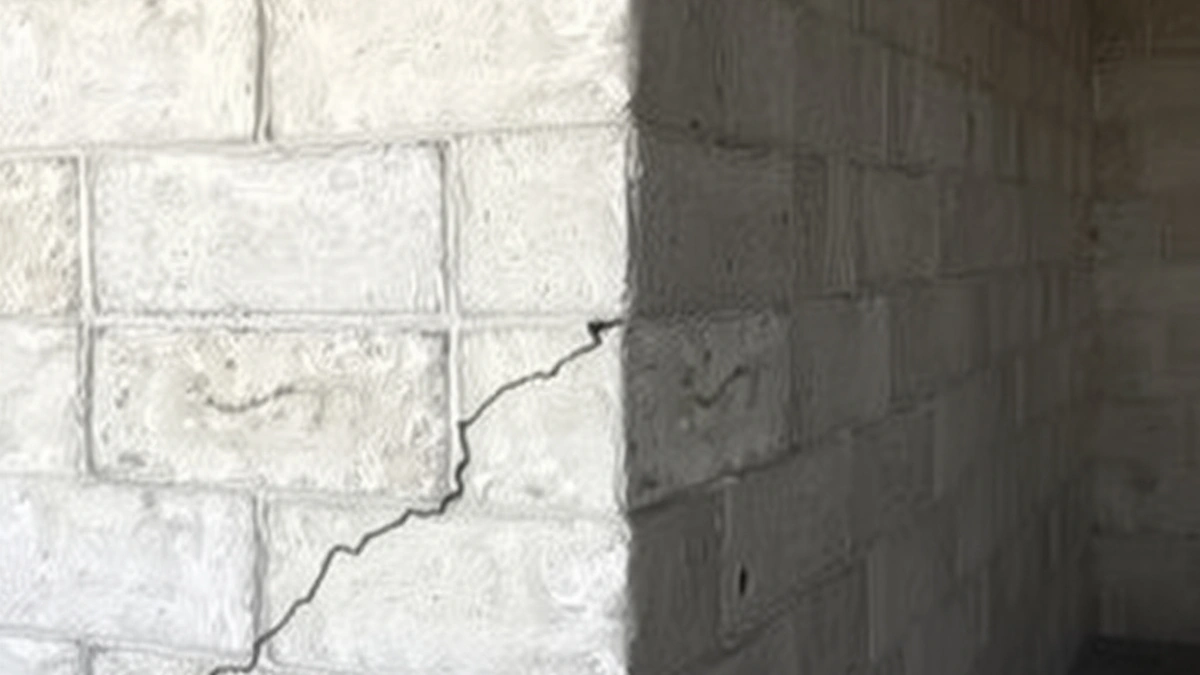
| Diagonal from a corner | Void or settlement at that corner | Lift and fill |
| Crack along a wall line | Differential movement | Investigate footing |
| Map cracking with spalling | Surface deterioration | Assess for replacement |
Draw the cracks on a sketch of the floor plan, with widths noted. That map is more useful to an engineer than a dozen photographs, because it shows the pattern rather than the detail.
Sealing Versus Lifting
Sealing a crack costs $400 to $1,200 and stops water. Lifting a slab costs $3 to $12 per sq ft and restores elevation. They solve different problems and are often done together: the void is filled, the slab is lifted, and the crack is injected afterward.
A 400 sq ft patio lifted with slurry at $6 per sq ft:
400 × $6 = $2,400
The same area with foam at $12 per sq ft:
400 × $12 = $4,800
The foam costs twice as much and weighs a fraction as much, which matters if the soil underneath is soft or the slab is thin.
When the Footing Has Moved
If the slab has settled because the footing has settled, lifting the slab alone will not hold. The footing needs support from below. Push piers run $1,000 to $3,000 each, helical piers run $700 to $2,500 each, and a typical house needs six to twelve.
A job with eight push piers at $2,000:
8 × $2,000 = $16,000
Add engineering at $1,000 and slab patching at $1,500:
$16,000 + $1,000 + $1,500 = $18,500
That sits in the $6,000 to $30,000 band and reflects a structural repair rather than a lift.
Post-Tension Slabs
A post-tension slab contains steel cables under high tension. Cutting one during a repair can release that energy violently, so no drilling or cutting should happen without a cable scan. The scan adds $300 to $700 and takes an hour.
If a contractor proposes to cut a post-tension slab without a scan, stop the job. The risk is injury, and the repair cost after a cut cable is far higher than the scan would have been.
One more condition deserves a check before lifting: the age of the plumbing. A slab lift moves every drain line under the floor, and older cast iron or galvanized pipe is brittle. If the house is pre-1980 and the drains have not been scoped, a camera inspection at $250 to $500 is cheap insurance against a pipe that breaks during the lift and turns a $4,000 job into a $9,000 one.
The Repair Sequence
- Map the cracks and record widths with dates.
- Tap-test for hollow areas and check floor elevation room by room.
- Confirm whether the slab is post-tensioned.
- Correct drainage and the water source that created the void.
- Fill voids and lift, or underpin the footing, to the engineer’s design.
- Patch the injection holes and restore the floor covering.
- Recheck elevations after one wet season.
Repair or Replace
Replace when the slab has broken into several pieces that move independently, when the concrete is deteriorating across a large area, or when the slab thickness and reinforcement are inadequate for the loads. Replacement is a larger project than most homeowners expect, because it involves removing the floor and protecting the services beneath.
For a slab that is intact and simply out of level, lifting is almost always the better spend. For a slab with a failed footing, piers are the answer. For a slab that has crumbled, replacement is the only repair that lasts.
Getting a Fair Price
Ask for the square footage being treated, the material being injected, and the number of injection points. Ask whether the price includes patching and whether drainage correction is separate. Then compare the per-square-foot rate rather than the total, because a 200 sq ft job and a 2,000 sq ft job carry different rates.
For the type context, read slab foundation repair and floating slab. If the slab is monolithic, monolithic slab explains how the pour affects movement, and slab lifting cost covers the injection pricing in detail.
Frequently asked questions
How much does concrete slab foundation repair cost?
Lifting and void filling run $3 to $12 per sq ft. Underpinning a settled footing runs $6,000 to $30,000, and crack injection runs $400 to $1,200 per crack.
How do I know if my slab needs repair?
Cracks at 1/8 inch or wider, a floor that has dropped more than an inch across a room, hollow spots underfoot, and doors that no longer close are the signals to investigate.
Can a cracked slab be repaired or must it be replaced?
Most cracked slabs are repaired. Replacement is reserved for slabs broken into several independently moving pieces or slabs with widespread deterioration.
What is the difference between a monolithic and a floating slab?
A monolithic slab pours the footing and floor together as one unit. A floating slab is separate from the footings and moves independently, which changes how cracks and settlement behave.
Are post-tension slabs harder to repair?
Yes. The tensioned cables cannot be cut without a scan, so drilling and excavation require a plan. The scan adds $300 to $700 and is not optional.
How long does slab repair last?
A lift or fill lasts as long as the cause is corrected. If water continues to wash out soil, the void returns, which is why drainage work usually accompanies the repair.
Sources
Some links are affiliate links.If you buy through them we may earn a commission at no extra cost to you. We do not accept payment for rankings. Read the full disclosure.