Concrete Block Foundations: What to Expect
Concrete block foundations are common in pre-1970 homes. Learn how CMU walls fail, how to read the cracks, and what repairs cost.
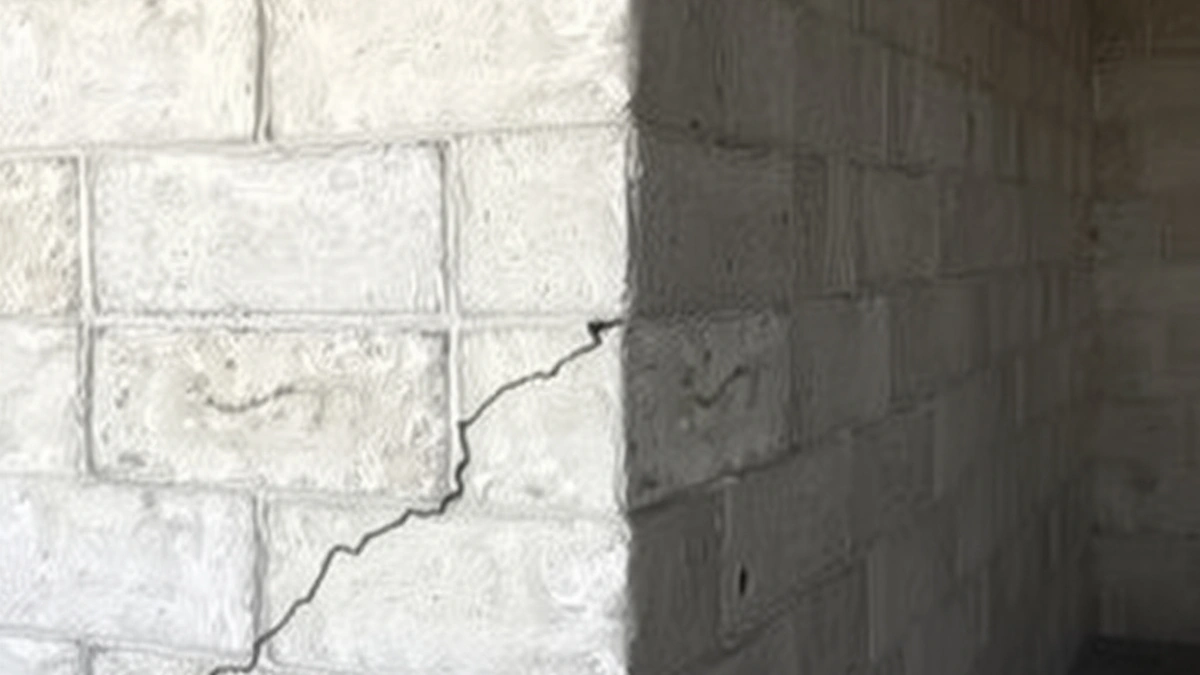
Concrete block foundations are built from hollow CMU units bedded in mortar, common from the 1920s to the 1960s. They fail along mortar joints, and repair runs $4,000 to $30,000 depending on whether the cause is settlement or soil pressure.
- Typical repair
- $4,000 - $15,000
- Underpinning job
- $6,000 - $30,000
- Carbon fibre strap
- $400 - $1,200
- Wall anchor each
- $500 - $1,500
- Monitor at crack width
- 1/8 inch
Some links on this page are affiliate links.If you buy through them we may earn a commission at no extra cost to you. We do not accept payment for rankings. Read the full disclosure.
Concrete block foundations are built from hollow concrete masonry units bedded in mortar, and they were the standard choice for homes from the 1920s through the 1960s. They fail along the mortar joints, which is both their weakness and their diagnostic value. The crack pattern tells you whether the cause is settlement or soil pressure.
What a Block Foundation Is
A concrete block foundation is a wall assembled from CMU blocks, typically 8 by 8 by 16 inches, laid in running bond with mortar between units. The hollow cores may be filled with concrete and rebar, or left empty. Older walls are usually unreinforced, which means the wall relies on its own weight and on the mortar bond for lateral stability.
That construction has one important consequence: the wall is a stack of units, and the joints are planes of weakness. Under vertical load the wall performs reasonably well in compression. Under horizontal load from soil it has very little tensile capacity, so it cracks where a poured wall might bend.
Reading the Crack Pattern
| Crack pattern | Likely cause | First step |
|---|---|---|
| Stair-step along mortar | Corner settlement | Elevation survey |
| Horizontal across courses | Lateral soil pressure | Check wall plumb |
| Vertical through block units | Shrinkage or point load | Measure and monitor |
| Diagonal from window corner | Settlement or lintel deflection | Engineer review |
A stair-step crack is the classic settlement signature. The wall drops at one corner and the crack follows the diagonal path of least resistance through the mortar. A horizontal crack is the pressure signature, and it usually appears at mid-height where the bending moment is greatest.
Why Block Walls Move
Settlement happens when the soil under one part of the footing compresses or washes away. Expansive clay, poorly compacted backfill, and a broken water line are common triggers. The wall does not crack because the block is weak; it cracks because one end is going down while the other stays put.
Lateral pressure happens when saturated soil pushes inward. The wall bows, the mortar cracks on the inside face, and the crack widens as the pressure continues. Poor drainage makes both problems worse and is almost always part of the story.
Repair Methods and Costs
| Method | Cost | Use |
|---|---|---|
| Crack injection | $400 - $1,200 | Leaking, stable cracks |
| Carbon fibre straps | $400 - $1,200 each | Bowing block walls |
| Wall anchors | $500 - $1,500 each | Active lateral pressure |
| Underpinning piers | $6,000 - $30,000 | Settlement |
| Section replacement | $20,000 - $40,000 | Crumbling or failed wall |
Injection seals a crack but does not restore strength. Carbon fibre straps are bonded vertically to the interior face and anchored at the floor and rim, which adds tensile capacity where the wall has none. Anchors tie the wall back to stable soil and can be tightened over time. Piers address the settlement that started the crack.
A Costed Example
A 28-foot block wall has settled 1 inch at one corner, with a stair-step crack at 3/16 inch. The engineer specifies five push piers at $2,000 each:
5 × $2,000 = $10,000
Add engineering at $400 to $1,500, plus tuckpointing the crack after the lift at $500:
$10,000 + $400 + $500 = $10,900 $10,000 + $1,500 + $500 = $12,000
That lands in the middle of the $4,000 to $15,000 repair band. If the same wall were bowing rather than settling, the method would change to anchors or straps and the total would be similar for a short wall.
What Filling Cores Does
Filling the cores with concrete and rebar is standard in new construction and adds both mass and continuity. In an existing wall it can add stiffness, but it does not correct the cause of movement, and pumping grout into a cracked wall without addressing the footing is treating the symptom.
If a contractor proposes core filling as the primary repair for a settled wall, ask what is being done about the soil underneath. If the answer is nothing, the wall will crack again at the next joint. Core filling is also not a waterproofing method, because grout does not bond to the block face and the wall still needs a drainage path.
The Sequence to Follow
- Photograph every crack with a scale and note the date.
- Measure wall plumb at three points with a 4-foot level or plumb line.
- Fix grading and downspouts so the soil stops loading the wall.
- Get an engineer’s report if any crack reaches 1/8 inch or the wall is out of plumb.
- Install piers for settlement or straps and anchors for bowing, as specified.
- Repair the masonry and re-inspect after one wet season.
Buying a House With a Block Foundation
A block foundation is not a defect by itself. Many have performed well for 80 years. What matters is drainage, crack width, and whether the wall is plumb. Ask for the seller’s disclosure, look for fresh paint over cracks, and get an engineer’s opinion rather than a contractor’s free estimate.
For the repair context, read foundation crack repair and stair-step foundation crack. If the wall is bowing rather than settling, carbon fibre versus wall anchors compares the two restraint methods.
Frequently asked questions
How long do concrete block foundations last?
A well-drained, unreinforced block wall can last 80 to 100 years or more. Water exposure and missing footing drains shorten that considerably by softening mortar and adding pressure.
Are block foundations weaker than poured concrete?
Yes, in bending. An unreinforced block wall has little tensile strength, so the mortar joints crack when soil pressure or settlement pushes the wall.
What does a stair-step crack in block mean?
A stair-step crack that follows the mortar joints usually indicates settlement at one end of the wall. A horizontal crack across several courses indicates lateral soil pressure instead.
Can a block foundation be repaired?
Yes. Settlement is corrected with underpinning piers, bowing is restrained with anchors or carbon fibre straps, and minor cracks are injected or repointed.
How much does block foundation repair cost?
Most repairs run $4,000 to $15,000. Underpinning a settled section runs $6,000 to $30,000, and replacing a failed wall section runs $20,000 to $40,000.
Should block cores be filled with concrete?
Filling cores adds mass and some strength, and it is often done during construction. Retrofitting cores in an existing wall is possible but does not correct the cause of movement.
Sources
Some links are affiliate links.If you buy through them we may earn a commission at no extra cost to you. We do not accept payment for rankings. Read the full disclosure.