Tree Roots Repair: Damage, Barriers, and Cost
Tree roots can dry soil, lift slabs, and crack foundations. See how to diagnose root damage and what a root barrier costs.
Tree roots damage foundations by drying soil and lifting slabs, not by pushing through concrete. Repair runs $500 to $4,000 for a root barrier, plus $400 to $30,000 for the structural work if movement has already occurred.
- Root barrier
- $8 - $20 per linear ft
- Tree removal
- $500 - $2,500
- Crack injection
- $400 - $1,200
- Pier repair
- $6,000 - $30,000
- Engineering report
- $400 - $1,500
Some links on this page are affiliate links.If you buy through them we may earn a commission at no extra cost to you. We do not accept payment for rankings. Read the full disclosure.
Tree roots repair is mostly about soil moisture, not about roots breaking concrete. Roots dry the soil under a footing, the soil shrinks, and the foundation settles. They also lift slabs and walks as they grow beneath them. A root barrier at $8 to $20 per linear foot is the usual prevention, and structural repair is separate.
How Roots Actually Cause Damage
Roots do not tunnel through sound concrete. They follow water and nutrients through gaps, cracks, and joints, and they expand as they grow. A root under a sidewalk lifts it; a root in a foundation crack widens it over years.
The larger effect is drying. A mature tree can draw a significant volume of water from the soil each day, and on expansive clay that withdrawal shrinks the soil and drops the footing. The damage appears as settlement at the corner nearest the tree, not as a root pushing through the wall.
Diagnosing Root Damage
| Sign | Likely root involvement |
|---|---|
| Settlement nearest a large tree | Soil drying |
| Crack pattern radiating from a tree | Root lifting or drying |
| Lifted sidewalk or patio near a tree | Root growth beneath |
| Crack in a wall following a root line | Root in the crack |
| Seasonal movement that tracks rainfall | Soil moisture cycle |
The location is the clue. Damage that is worst on the side of the house nearest the largest tree, and that improves after a wet season, points to root-driven soil movement.
Root Barriers
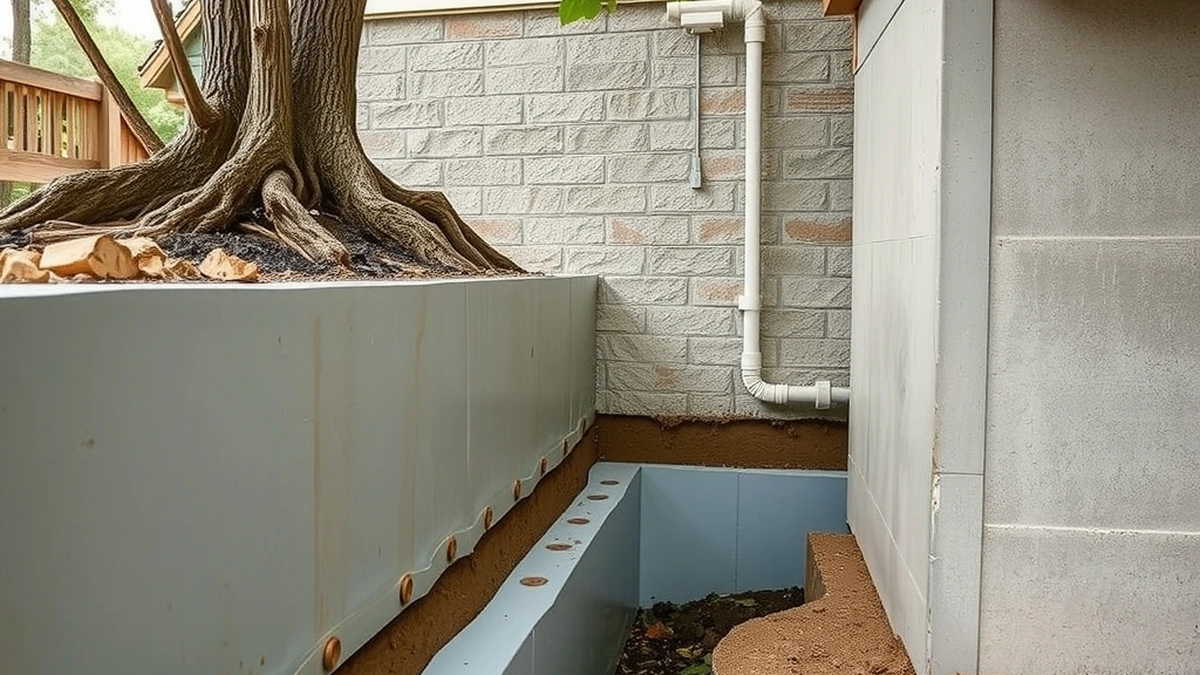
A root barrier is a rigid panel installed in a trench between the tree and the foundation. It forces roots to turn rather than grow into the protected zone. Installation typically runs $8 to $20 per linear foot.
A 50-foot barrier at $12 per foot:
50 × $12 = $600
Add excavation, disposal, and soil replacement, and the job commonly lands at $500 to $4,000. The depth matters: a shallow barrier only deflects surface roots, while a barrier 24 to 36 inches deep handles most residential species.
Tree Removal Versus Barrier
| Option | Cost | Effect |
|---|---|---|
| Root barrier | $500 - $4,000 | Preserves tree, stops new growth |
| Tree removal | $500 - $2,500 | Stops water uptake, can cause heave |
| Pruning | $200 - $800 | Reduces water demand temporarily |
| Structural repair | $6,000 - $30,000 | Fixes movement already caused |
Removing a large tree is not always the right answer. The soil that was kept dry by the tree can swell after removal, and that swelling can heave a foundation that was previously stable. Removal should be decided with an arborist and an engineer, not by the homeowner alone.
Structural Repair After Root Damage
If the foundation has already moved, the barrier stops further root growth but does not restore the footing. The structural repair is the same as for any settlement: piers at $1,000 to $3,000 each for push piers, or $700 to $2,500 for helical.
A costed example with five push piers at $2,000 and a 40-foot barrier at $12 per foot:
Piers: 5 × $2,000 = $10,000 Barrier: 40 × $12 = $480 Engineering: $900 Total: $11,380
That is a moderate repair, and the barrier is a small fraction of it. The barrier is the part that keeps the repair from being repeated.
The Sequence
- Identify the trees within 20 feet of the foundation.
- Map the damage and check whether it is worst on the tree side.
- Get an arborist’s assessment before removing anything.
- Install a root barrier at the recommended depth.
- Repair the structural movement with piers if the footing has settled.
- Manage irrigation so the soil moisture stays consistent.
Living With Large Trees
Large trees near a house are an asset, and most do not cause foundation damage. The risk rises with species, soil type, and distance. Willow, poplar, and silver maple are more aggressive than oak and birch, and clay soil transmits the effect more than sandy soil.
Keep the tree watered evenly during drought rather than letting it strip the soil dry, and keep the foundation soil watered as well. Consistent moisture is the goal, and it is cheaper than either a barrier or a repair.
Species matters more than size in most cases. Willows, poplars, and silver maples seek water aggressively and can pull a clay yard dry within a season. Oaks and hollies are slower and less demanding. A certified arborist can identify the species, estimate the root spread, and recommend a barrier depth or a removal plan that does not leave the soil in a worse condition than the tree did.
When to Call an Engineer
Call one when the movement is localized to the tree side, when cracks are widening, or when a previous repair has not held. An engineer at $400 to $1,500 can separate root-driven movement from settlement caused by drainage or fill, and the repair differs. Bring the arborist’s report and your rainfall notes to that visit, since both help establish whether the movement tracks the tree or the weather.
For the soil side, read expansive clay soil and tree roots foundation. If a barrier is part of the plan, root barrier installation covers the trench and panel details.
Frequently asked questions
Can tree roots damage a foundation?
Roots rarely push through sound concrete. They damage foundations by drying and shrinking the soil under a footing, and by lifting slabs and walks as they grow beneath them.
How much does a root barrier cost?
A root barrier typically runs $8 to $20 per linear foot installed, so a 50-foot run costs $400 to $1,000. Access and depth change the price.
Should I remove the tree or install a barrier?
A barrier is usually cheaper and preserves the tree. Removal is warranted when the tree is already causing structural movement, is diseased, or is too close to the foundation to manage.
How close can a tree be to a house?
The common guidance is to keep large trees at least 10 to 20 feet from the foundation, depending on species and soil. Fast-growing species with aggressive roots need more distance.
Does tree root damage show up as cracks?
Yes. Soil drying produces settlement cracks, and root lifting produces cracks in slabs and walks. The pattern helps distinguish root damage from other causes.
Will a root barrier stop existing damage?
No. A barrier prevents new root growth into the protected zone. Movement that has already occurred needs structural repair in addition to the barrier.
Sources
Some links are affiliate links.If you buy through them we may earn a commission at no extra cost to you. We do not accept payment for rankings. Read the full disclosure.