How Soil Stabilisation Works: Grout and Lime
Soil stabilisation improves the ground under a foundation with grout, lime, or compaction. See how each method changes the soil.
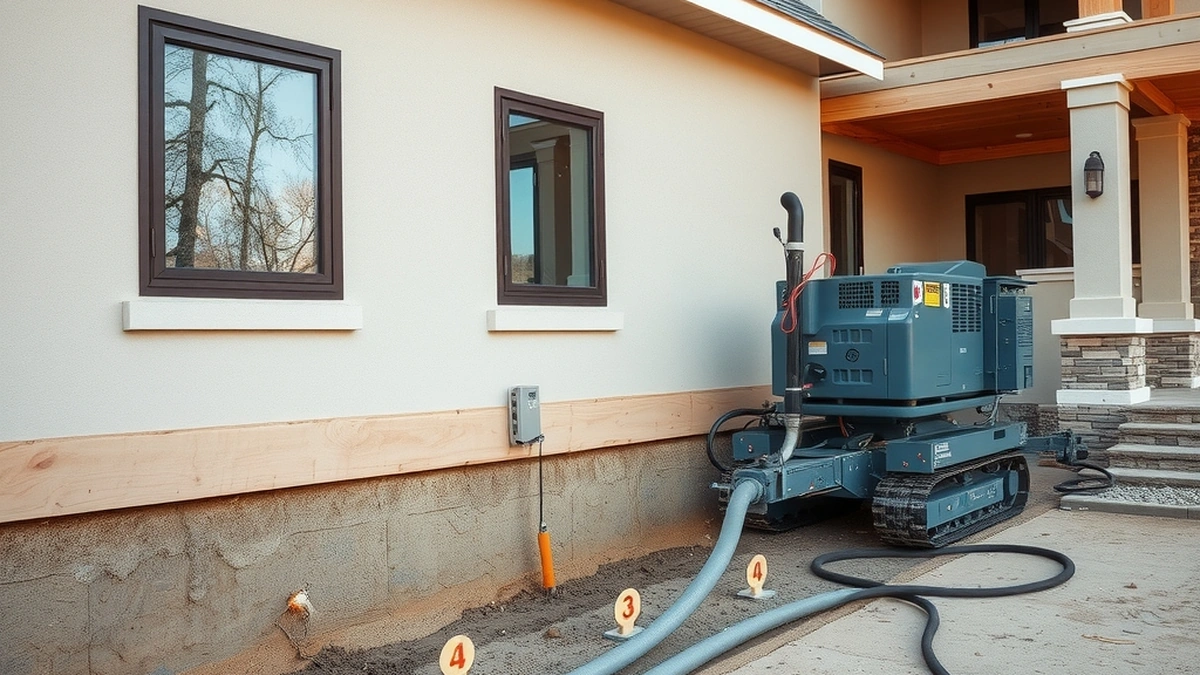
Soil stabilisation works by injecting grout to fill voids and bind loose soil, mixing lime or cement to reduce volume change, or compacting to increase density. A typical residential job costs $2,000 to $15,000.
- Grouting
- $3 - $10 per sq ft
- Lime treatment
- $2 - $6 per sq ft
- Typical job
- $2,000 - $15,000
- Verification
- Elevation or density test
- Engineering report
- $400 - $1,500
Some links on this page are affiliate links.If you buy through them we may earn a commission at no extra cost to you. We do not accept payment for rankings. Read the full disclosure.
Soil stabilisation works by changing the ground rather than the foundation. Grout fills voids and binds loose particles, lime or cement mixing reduces the soil’s tendency to swell and shrink, and compaction increases density. A typical residential job costs $2,000 to $15,000, and the technique has to match the soil.
Why Soil Moves
Soil moves for three reasons. It compresses under load when it is loose or organic. It changes volume with moisture when it contains expansive clay. It washes away when water carries fines through it.
Each reason needs a different treatment. Compaction addresses loose soil. Lime treatment addresses expansive clay. Grouting addresses voids and washed-out zones. Applying the wrong one is the most common way a stabilisation budget is wasted.
Grouting
Grouting injects a cementitious or chemical mix into the soil under pressure. The grout fills voids, displaces water, and sets, creating a stronger mass. It is used under slabs, along footings, and in loose fill.
Compaction grouting uses a stiff mix that expands the surrounding soil as it is injected, which densifies loose layers at depth. Permeation grouting uses a thinner mix that flows into pores and sets, which is used in granular soils.
Lime Treatment
Lime treatment mixes hydrated lime into expansive clay. The lime reacts with the clay minerals, reducing their ability to absorb water and swell. The result is a soil that moves less with the seasons.
The treatment is done by tilling lime into the soil at the specified depth and dosage, then compacting and curing. The reaction generates heat and consumes water, so the mix has to be placed and compacted within a working window after mixing. It is most practical on new construction or on sites where the soil can be exposed, because the mixing requires access. Under an existing slab, lime treatment is rarely an option, which is why deep piers are the usual repair for an existing house on expansive clay.
Compaction
| Method | Cost | Target |
|---|---|---|
| Surface compaction | $1 - $3 per sq ft | Loose fill near grade |
| Deep compaction | $6 - $12 per sq ft | Loose layers at depth |
| Lime treatment | $2 - $6 per sq ft | Expansive clay |
| Cement mixing | $4 - $9 per sq ft | Soft cohesive soil |
Compaction increases density and reduces future settlement. It is the simplest of the techniques and the one most often specified for fill that was placed without proper compaction.
Compaction is also the cheapest and the most limited. It works on soil that is loose but otherwise suitable. It cannot fix clay that swells, and it cannot fill a void that has already opened under a slab.
A Costed Example
A 500 sq ft area of loose fill under a garage slab, treated with compaction grouting at $9 per sq ft:
500 × $9 = $4,500
Add mobilization at $500 and a verification survey at $400:
$4,500 + $500 + $400 = $5,400
That sits in the middle of the $2,000 to $15,000 band.
The Sequence
- Get a geotechnical report with soil classification.
- Identify the deficiency: loose, expansive, or voided.
- Select the technique and dosage with the engineer.
- Protect utilities and establish monitoring points.
- Treat the soil in the specified pattern.
- Verify with elevation or density testing.
- Restore the surface and monitor.
Stabilisation without verification is a guess. For lifting work, the verification is an elevation reading before and after. For compaction and mixing, it is a density test or a penetration test at specified points.
Ask how the result will be measured before the work starts. A contractor who cannot describe the verification method is treating the soil by feel, and feel is not a specification.
For a small residential job, the verification may be as simple as a laser level reading on the slab before and after. For a larger site, it may be a plate load test or a cone penetration test. Either way, the number should be written down and compared with the design target.
Limits
Stabilisation improves the soil that is there. It does not create bearing capacity at depth where none exists, and it does not replace a pier that reaches a competent stratum. If the footing has already settled significantly, the repair is underpinning.
It also does not fix the water. If the site still drains toward the foundation, the treated soil will eventually be affected the same way as the original. Water management is part of the solution, not an optional extra. Extending downspouts and regrading are cheap compared with a second round of treatment, and they are the difference between a stabilised site and a stabilised site that stays that way.
What to Ask a Contractor
Ask what technique, what depth, and what dosage. Ask how the result will be verified and whether the geotechnical report is included. Ask what happens if the treatment does not achieve the target, and who pays for the second pass. A contractor who guarantees the result in writing is either confident in the design or planning to charge for the retry, and the contract should make clear which.
For the cost detail, read what soil stabilisation costs and soil stabilization. If the issue is a settled footing rather than the soil, underpinning cost is the closer comparison.
Frequently asked questions
How does soil stabilisation work?
It changes the soil's engineering properties: grout fills voids and binds particles, lime reduces clay's volume change, and compaction increases density. The goal is soil that can support the foundation without moving.
How much does soil stabilisation cost?
Grouting runs $3 to $10 per sq ft and lime treatment $2 to $6 per sq ft. A typical residential job lands between $2,000 and $15,000.
Does soil stabilisation work on expansive clay?
Lime treatment can reduce the swell potential of clay, and moisture control reduces the cycle. Severe cases may still need deep piers or soil replacement.
Is soil stabilisation permanent?
Cementitious grout and lime treatment are permanent within their design life. Performance depends on the dosage, the soil, and continued water management.
Can soil stabilisation lift a settled slab?
Grout injection can fill voids and lift a slab as a secondary effect. Structural settlement of a house still needs piers that reach bearing soil.
How is the result verified?
By elevation readings for lifting work, and by density or penetration testing for compaction and mixing. The method should be agreed before the work starts.
Sources
Some links are affiliate links.If you buy through them we may earn a commission at no extra cost to you. We do not accept payment for rankings. Read the full disclosure.