Soil Stabilisation for Foundations: Methods and Costs
How soil stabilisation works for foundation repair, when it applies, and what common methods cost in the US.
Soil stabilisation improves the ground beneath a foundation using compaction, grout, foam, piers, or drainage, with costs typically ranging from $3 per square foot for mudjacking to $30,000 for full pier jobs.
- Typical scope
- Measure soil movement, then stabilise or support the foundation
- Common methods
- Mudjacking, poly foam, piers, drainage, chemical grout
- Cost range
- $3–$15 per square foot for lifting; $6,000–$30,000 for pier jobs
- Inspection lead time
- 1–2 weeks
Some links on this page are affiliate links.If you buy through them we may earn a commission at no extra cost to you. We do not accept payment for rankings. Read the full disclosure.
What Soil Stabilisation Means
Soil stabilisation for foundations is the process of changing the physical properties of the ground beneath or around a structure so it can support loads without excessive movement. The first step is always measurement: crack width, vertical displacement, and depth to stable bearing. Method selection comes second. Price comes third.
Cracks wider than 1/16 inch are generally considered beyond cosmetic. Cracks near 1/8 inch enter a watch category. Wall movement approaching 2 inches often indicates a structural issue that soil stabilisation alone may not correct. These numbers guide whether the right response is slab lifting, pier installation, drainage work, or a combination.
Common Stabilisation Methods
Several methods are used to stabilise soil and support foundations. Each fits different soil conditions and foundation types.
Mudjacking (slab jacking) pumps a cementitious grout under a settled slab to lift it back toward its original position. Cost typically ranges from $3 to $8 per square foot. For a 500-square-foot garage slab, the material and labor estimate is $1,500 to $4,000. Expected service life is roughly 5 to 15 years.
Polyurethane foam injection expands beneath slabs to fill voids and lift concrete. Cost typically ranges from $5 to $15 per square foot. For the same 500-square-foot slab, the estimate is $2,500 to $7,500. Foam is lighter than grout and cures quickly, but it is not appropriate for every soil condition.
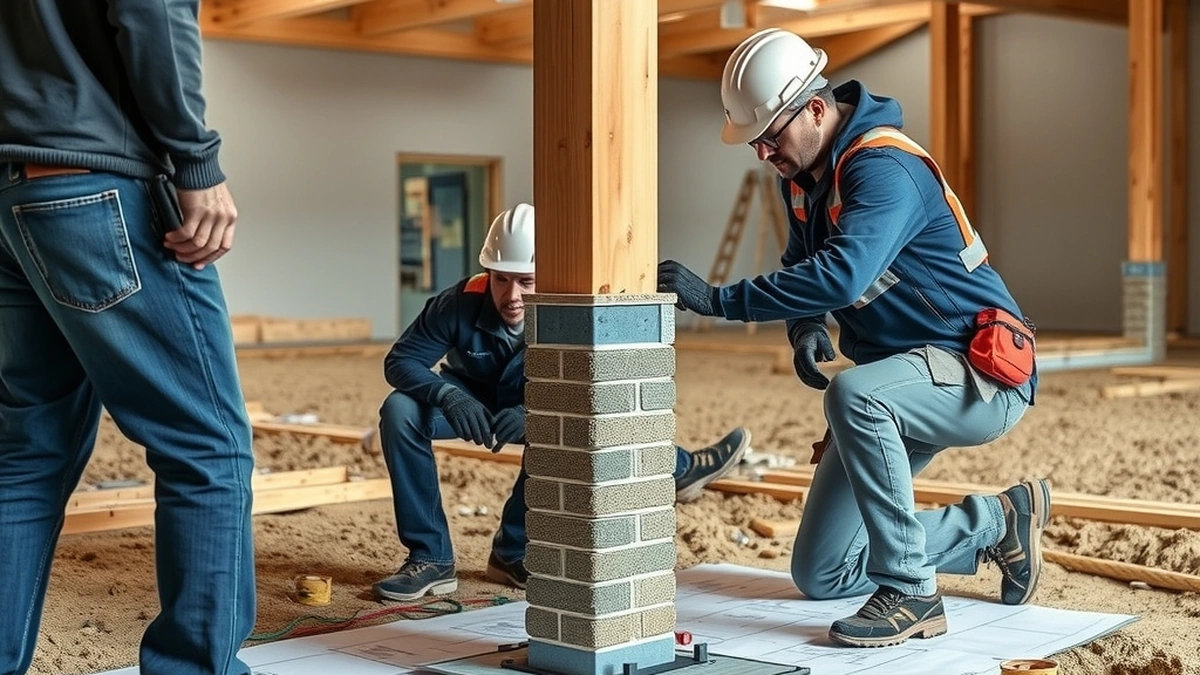
Push piers are steel sections driven to load-bearing soil or bedrock, then used to lift and support the foundation. Unit cost is typically $1,000 to $3,000 per pier. A job using eight piers at $2,000 each would be approximately $16,000 before permits, engineering, and restoration. Full pier jobs commonly total $6,000 to $30,000.
Helical piers are screwed into the ground and are often used where soil conditions make driving impractical. Unit cost is typically $700 to $2,500 per pier. Eight piers at $1,500 each would be approximately $12,000, with full jobs also falling in the $6,000 to $30,000 range.
Drainage and moisture control addresses the water that causes expansive soils to swell and contract. This can include grading, gutters, downspout extensions, and crawl space encapsulation. Crawl encapsulation typically costs $3 to $8 per square foot, or $4,000 to $15,000 per job depending on size and conditions.
| Method | Typical Unit Cost | Example Calculation | Notes |
|---|---|---|---|
| Mudjacking | $3–$8 per sq ft | 500 sq ft × $5 = $2,500 | Best for concrete slabs with accessible voids |
| Polyurethane foam | $5–$15 per sq ft | 500 sq ft × $10 = $5,000 | Fast cure, lightweight fill |
| Push piers | $1,000–$3,000 each | 8 piers × $2,000 = $16,000 | Transfers load to bearing stratum |
| Helical piers | $700–$2,500 each | 8 piers × $1,500 = $12,000 | Installed by torque, not driving |
| Crawl encapsulation | $3–$8 per sq ft | 1,000 sq ft × $5 = $5,000 | Controls moisture under the home |
How to Measure Before Choosing a Method
Start with observable data. Measure crack width at the widest point. Record vertical displacement at interior and exterior points. Note whether doors stick, floors slope, or walls separate from framing. These measurements determine whether soil stabilisation, pier support, or wall reinforcement is appropriate.
A foundation crack under 1/16 inch is usually cosmetic and may not require structural repair. Cracks approaching 1/8 inch warrant monitoring. Lateral wall movement near the 2-inch limit generally requires structural intervention, not soil treatment alone. Depth to bearing soil or bedrock determines pier length and therefore pier count and cost.
An engineer inspection typically costs $400 to $1,500 and usually has a lead time of 1 to 2 weeks. The inspection should identify bearing depth, load requirements, and whether stabilisation can be localised or must span the full foundation.
When Soil Stabilisation Is Not Enough
Stabilising soil does not fix a foundation that has already failed structurally. If more than one-third of the foundation has failed or movement exceeds safe limits, replacement may be the only durable option. Foundation replacement typically costs $40,000 to $150,000, depending on home size and access.
Average foundation repair costs $4,000 to $15,000. Major repairs run $20,000 to $40,000. Restoration after pier installation typically adds 10 to 25 percent of the structural cost for landscaping, concrete patching, and interior drywall repair.
Wall anchors cost $500 to $1,500 each and are used for bowing basement walls, not soil stabilisation under slabs. Carbon fibre straps cost $400 to $1,200 each and reinforce cracked foundation walls. These are wall repair methods, not soil improvement techniques, and should not be confused with ground stabilisation.
Permits, Warranties, and Timing
Permit requirements vary by city and county and typically take 1 to 3 weeks to process. Inspection lead time is usually 1 to 2 weeks. Warranty terms differ by method: pier warranties are often lifetime and transferable, while mudjacking and foam lifting carry shorter performance windows. Warranty transfer fees typically range from $100 to $500.
Soil stabilisation is a measurement-driven repair. Confirm the soil condition, measure the movement, select the method matched to the data, then price the scope. That sequence protects the homeowner from unnecessary work and mismatched solutions.
For more detail on specific repair paths, see foundation repair cost, pier and beam foundation repair cost, foundation crack repair cost, mudjacking cost, helical pier cost, push pier cost, carbon fiber foundation repair cost, and wall anchor cost.
Next, compare foundation repair cost, pier and beam foundation repair cost, foundation crack repair cost before you commit.
Frequently asked questions
What is soil stabilisation for foundations?
Soil stabilisation means improving the strength, density, or drainage of soil under or around a foundation so it stops shifting and supports the structure.
When is soil stabilisation needed?
It is considered when measurements show slab settlement, foundation movement, or expansive soil causing cracks beyond cosmetic limits.
How much does mudjacking cost per square foot?
Mudjacking typically costs $3 to $8 per square foot, depending on access, void size, and local labor rates.
How much does polyurethane foam lifting cost per square foot?
Polyurethane foam lifting typically costs $5 to $15 per square foot, including material and injection labor.
What do piers cost per unit?
Push piers cost about $1,000 to $3,000 each; helical piers cost about $700 to $2,500 each; full pier jobs often run $6,000 to $30,000.
Do I need an engineer before stabilising soil?
An engineer inspection usually costs $400 to $1,500 and is recommended to confirm bearing depth, load, and the correct repair method.
Sources
Some links are affiliate links.If you buy through them we may earn a commission at no extra cost to you. We do not accept payment for rankings. Read the full disclosure.