Underpinning Cost per Foot: What the Number Means
Underpinning runs $700 to $3,000 per pier, which works out to roughly $90 to $375 per linear foot of wall. See the arithmetic behind the range.
Underpinning works out to about $90 to $375 per linear foot of wall, derived from piers at $700 to $3,000 each spaced 6 to 10 feet apart. A 100-foot wall typically runs $9,000 to $37,500.
- Cost per linear foot
- $90 - $375
- Push pier each
- $1,000 - $3,000
- Helical pier each
- $700 - $2,500
- Typical pier job
- $6,000 - $30,000
- Engineering inspection
- $400 - $1,500
Some links on this page are affiliate links.If you buy through them we may earn a commission at no extra cost to you. We do not accept payment for rankings. Read the full disclosure.
Underpinning costs roughly $90 to $375 per linear foot of wall, but nobody installs a linear foot of underpinning. Contractors install piers. The per-foot figure is derived from the pier price divided by the spacing the engineer specifies, which is why two quotes for the same wall can differ by thousands of dollars without either one being dishonest.
What Underpinning Is
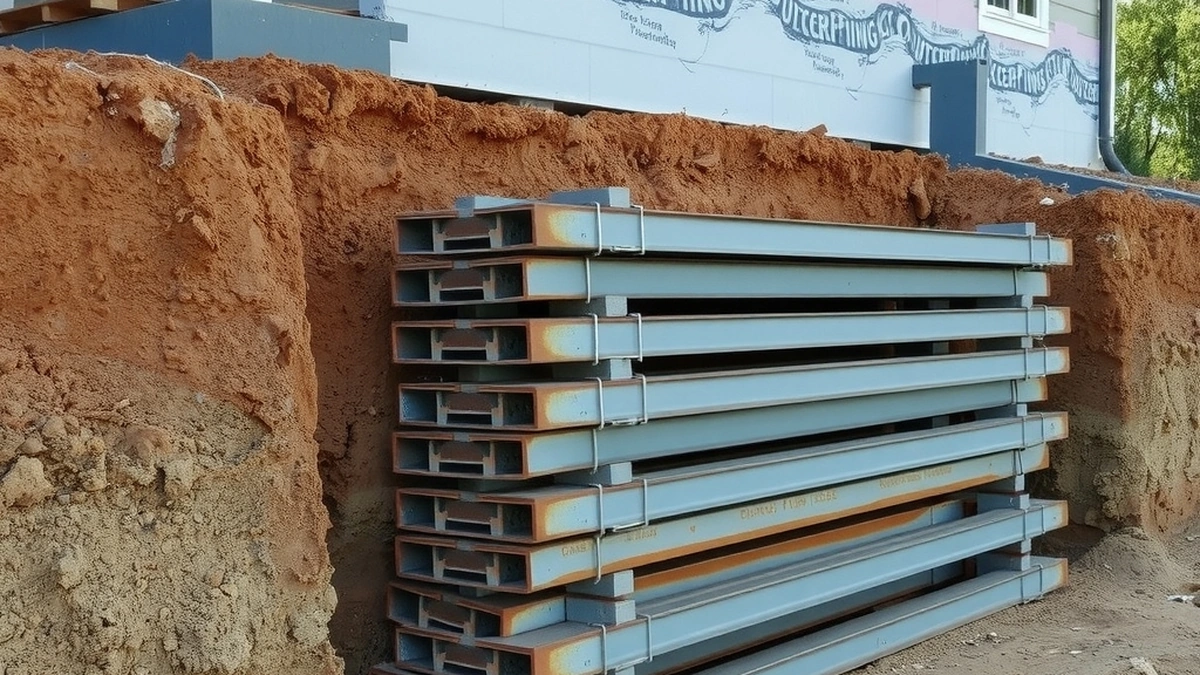
Underpinning is the installation of new, deeper support beneath an existing foundation so that building loads bypass weak or settling soil. Steel piers are driven or screwed to a bearing stratum, brackets are attached to the existing footing, and the load is transferred from the old soil to the new pier.
The work is done in short sections so the wall above stays supported. On a push pier system, a bracket is bolted to the exposed footing and hydraulic rams drive steel tube sections down until they reach refusal. On a helical system, a torque motor rotates a shaft with helical plates into the ground until the required torque is reached.
How the Per-Foot Number Is Built
The arithmetic is short. Take the pier price and divide by the spacing:
- Push pier at $1,800 spaced 8 feet apart: $1,800 ÷ 8 = $225 per linear foot
- Helical pier at $1,200 spaced 10 feet apart: $1,200 ÷ 10 = $120 per linear foot
- Push pier at $3,000 spaced 8 feet apart: $3,000 ÷ 8 = $375 per linear foot
- Helical pier at $700 spaced 8 feet apart: $700 ÷ 8 = $87.50 per linear foot
That is where the $90 to $375 range comes from. Both ends are real. A shallow helical job on firm soil sits at the low end, and a deep push pier job on expansive clay sits at the high end.
Cost per Foot by Scope
| Scope | Linear feet | Cost per foot | Total |
|---|---|---|---|
| One wall, helical | 30 | $120 | $3,600 |
| One wall, push piers | 40 | $225 | $9,000 |
| Two walls, push piers | 80 | $225 | $18,000 |
| Three walls plus garage | 120 | $260 | $31,200 |
These totals exclude engineering, permits, and interior restoration. Adding an inspection at $400 to $1,500 to the $18,000 example gives $18,400 to $19,500, which still sits inside the $6,000 to $30,000 full-job band.
What Moves the Price
Depth is the largest variable. Piers are priced per unit in many quotes, but the unit assumes a typical depth. If bearing soil sits at 30 feet instead of 15, the contractor uses twice the steel and twice the driving time, and a fair quote will reflect that. In northern states the design also has to clear the local frost line, which can add several feet to every pier in the run.
Access is second. A wall with a clear exterior trench is fast. A wall that must be underpinned from inside a finished basement means removing and replacing slab and flooring, and that restoration can add 10% to 25% on top of the structural cost. Soil type is third: expansive clay, fill, and organic soils all require deeper penetration to reach something that will hold.
A Full Example
A 1950s ranch has settled along a 50-foot side wall. The engineer specifies 7 push piers at 8-foot spacing:
50 ÷ 8 = 6.25, rounded up to 7 piers
At $2,100 each:
7 × $2,100 = $14,700
Add engineering at $400 to $1,500:
$14,700 + $400 = $15,100 $14,700 + $1,500 = $16,200
Add interior restoration at 10% to 25%:
$14,700 × 0.10 = $1,470 $14,700 × 0.25 = $3,675
All-in: $16,570 to $19,875, or about $331 to $397 per linear foot once everything is included. That is why the per-foot figure quoted on a website is a starting point, not a bid.
Underpinning Versus Other Repairs
| Method | Typical cost | What it solves |
|---|---|---|
| Underpinning | $6,000 - $30,000 | Deep settlement, failed footings |
| Mudjacking | $3 - $8 per sq ft | Shallow slab voids |
| Wall anchors | $500 - $1,500 each | Bowing, not settlement |
| Full replacement | $40,000 - $150,000 | Foundation beyond repair |
Underpinning addresses load transfer to deeper soil. It does not fix a bowing wall, which is a lateral load problem solved with anchors or carbon straps, and it does not fill voids under an interior slab, which is a lifting problem. Matching the method to the failure is the whole job, and that is also what separates a sensible underpinning quote from a full foundation replacement sales pitch.
Working With a Contractor
- Get a written engineer’s report with pier type, spacing, and design depth.
- Ask for a per-pier price and a stated count, not a lump sum.
- Confirm what depth is included and how overruns are billed.
- Check that the quote separates structural work from restoration.
- Verify the licence and insurance before any excavation starts.
Reading a Quote Correctly
A quote that says “underpinning, $18,000” tells you nothing you can compare. A quote that says “seven push piers at 8-foot spacing, design depth 25 feet, $2,100 each, engineering included” tells you everything. Ask for the second kind.
For the broader cost picture, see foundation repair cost, and if the engineer is choosing between steel systems, read push piers versus helical piers before the method is fixed.
Frequently asked questions
How much does underpinning cost per linear foot?
Plan on $90 to $375 per linear foot of wall, calculated from pier prices of $700 to $3,000 spread across 6 to 10 feet of wall per pier.
Why do contractors quote per pier instead of per foot?
Pier count is set by soil depth and load points, not by wall length alone. A per-pier quote shows exactly what you are buying and makes bids comparable.
How far apart are underpinning piers spaced?
Most engineers specify 6 to 10 feet along the affected wall, with additional piers at corners, chimneys, and other concentrated loads.
Does the price include excavation?
Usually yes for exterior access trenches. Interior access, finished basement floors, and landscaping restoration are often excluded and should be listed separately.
Is underpinning cheaper than replacing the foundation?
Yes in most cases. Underpinning typically runs $6,000 to $30,000, while full replacement runs $40,000 to $150,000, so replacement is reserved for foundations that cannot be saved.
How long does underpinning last?
A steel pier driven to competent bearing soil is designed to last the life of the structure, and the warranty is commonly transferable for a $100 to $500 fee at resale.
Sources
Some links are affiliate links.If you buy through them we may earn a commission at no extra cost to you. We do not accept payment for rankings. Read the full disclosure.