How much should foundation repair cost
Benchmark prices for foundation repair, unit rates to check a quote against, and the signals that a bid is priced too high or too low.
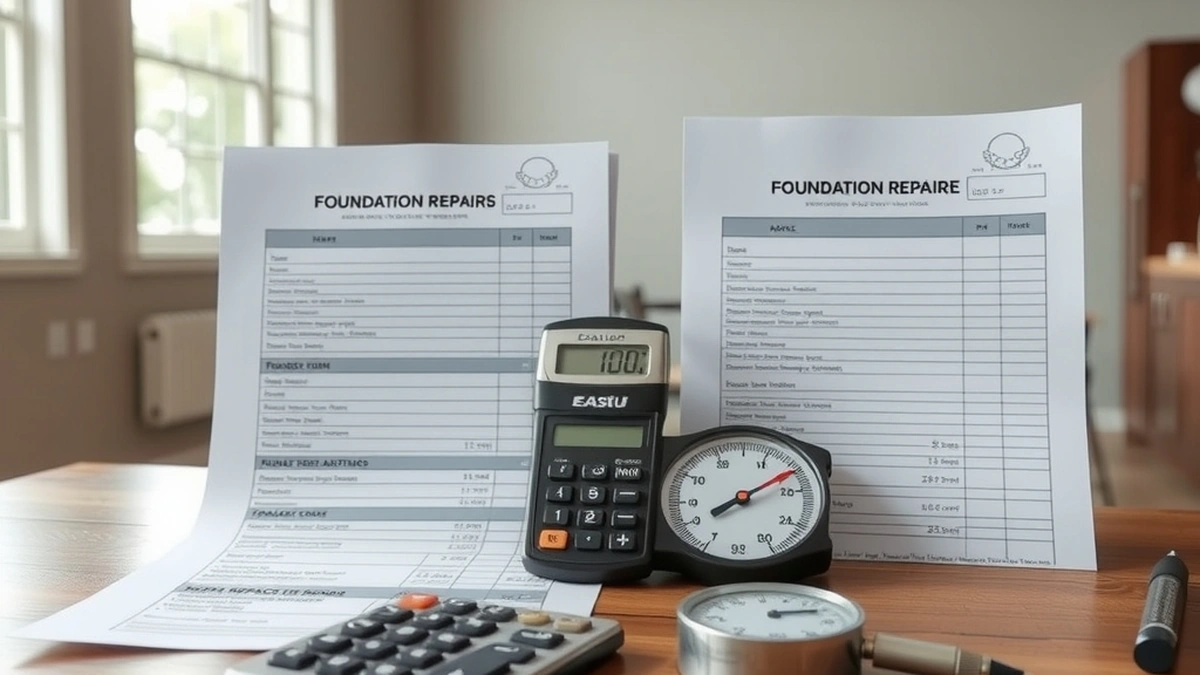
Foundation repair should cost $4,000 to $15,000 for a typical home, with piers at $700 to $3,000 each and slab lifting at $3 to $12 per square foot. A fair price is a unit rate plus separately listed engineering, permits, and restoration.
- Typical range
- $4,000 - $15,000
- Major repair
- $20,000 - $40,000
- Push pier each
- $1,000 - $3,000
- Helical pier each
- $700 - $2,500
- Engineering report
- $400 - $1,500
Some links on this page are affiliate links.If you buy through them we may earn a commission at no extra cost to you. We do not accept payment for rankings. Read the full disclosure.
Foundation repair should cost $4,000 to $15,000 for a typical home, with major structural work at $20,000 to $40,000. Within those totals, the checkable numbers are the unit rates: $1,000 to $3,000 per push pier, $700 to $2,500 per helical pier, $3 to $12 per square foot for slab lifting, and $400 to $1,500 for the engineering report. A price is fair when the units and the scope line up.
The benchmark ranges
These are the published US ranges used across this site, and they are estimates rather than quotes.
| Scope | Typical range |
|---|---|
| Average residential repair | $4,000 - $15,000 |
| Major structural repair | $20,000 - $40,000 |
| Full foundation replacement | $40,000 - $150,000 |
| Restoration as share of structural | 10% - 25% |
A quote inside those bands can still be wrong if the scope is wrong. A $9,000 pier job that installs four piers where the engineer specified eight is not a good price; it is a different, smaller job that will not fix the problem.
Unit rates to check
| Item | Unit | Range |
|---|---|---|
| Push pier | each | $1,000 - $3,000 |
| Helical pier | each | $700 - $2,500 |
| Slab lifting | square foot | $3 - $12 |
| Mudjacking | square foot | $3 - $8 |
| Polyurethane foam | square foot | $5 - $15 |
| Wall anchor | each | $500 - $1,500 |
| Carbon fibre strap | each | $400 - $1,200 |
| Crawl space encapsulation | square foot | $3 - $8 |
Divide the subtotal by the quantity to get the effective rate. A bid of $18,000 for ten push piers is $1,800 per pier, which sits mid-band. A bid of $18,000 for six push piers is $3,000 per pier, which sits at the top of the band and needs a reason: deep bearing, difficult access, or heavy load.
Reading a quote line by line
- Check that the diagnosis is written down: crack widths, floor elevations, and the direction of movement.
- Count the piers and compare with the engineer’s specified spacing.
- Divide the pier subtotal by the count to get the effective unit price.
- Confirm whether engineering and permits are inside the total or added later.
- Confirm the restoration allowance: patching, drywall, paint, and flooring.
- Ask what the crew does if the target depth is not reached on the first attempt.
A quote that fails at step 2 or step 4 cannot be compared with anything. That is the point of asking for the breakdown.
What regional variation looks like
Labor rates and soil conditions move prices within the bands rather than outside them. A market with deep expansive clay needs longer piers, so the unit price trends toward the top. A market with shallow rock needs shorter piers and trends toward the bottom.
The practical effect is that a $12,000 job in one state can be a $22,000 job in another for the same house plan. That does not mean one contractor is overcharging. It means the depth and the labor rate are different.
For state-level context, see foundation repair cost by state.
Signs a price is too high
The unit price sits above the band with no explanation of depth or access. Engineering is bundled into a lump sum so you cannot see what it cost. The quote includes a “lifetime warranty” as a paid upgrade rather than a standard term. The scope lists a pier count without locations. The contractor will not put the target depth in writing.
One high line is not proof of overcharging. A pattern of them is a reason to get a second bid with the same scope.
Signs a price is too low
The count is lower than the engineer specified. The quote excludes permits, engineering, or restoration and those appear later as change orders. The crew plans to use mudjacking at $3 per square foot to solve a footing problem that needs piers. The warranty is verbal. The deposit request is large and the schedule is vague.
A low bid that skips engineering is not a saving. It shifts the risk of an undersized repair onto the homeowner, and the same wall often needs a second repair within a few years.
Putting the arithmetic together
Take a house where the engineer specifies seven helical piers at a target depth of 20 feet, plus a drainage correction.
Seven helical piers at $1,400 each is 7 x $1,400 = $9,800. Engineering is $750. Permits and mobilization are $900. Restoration is $600. The total is $9,800 + $750 + $900 + $600 = $12,050.
If a second bid comes in at $8,400 with five piers and no engineering, the difference is $12,050 - $8,400 = $3,650, and most of that gap is the two missing piers and the report. The second bid is not cheaper for the same work.
For method detail, see push pier cost and helical pier cost. For the full method comparison, foundation repair cost covers every option. Before signing, foundation repair quote explains what a complete bid contains.
Bottom line
Foundation repair should cost $4,000 to $15,000 for most homes, built from unit rates that can be checked. Compare pier counts and unit prices, not grand totals, and treat a missing engineering line as a missing part of the job rather than a discount.
Frequently asked questions
What is a fair price for foundation repair?
A fair price sits inside the published unit bands, with engineering, permits, and restoration listed separately rather than folded into a lump sum.
Why is one quote much cheaper than another?
A low quote often uses fewer piers, shallower depths, or excludes engineering and permits, so the scopes have to be compared line by line.
Should I choose the lowest bid?
No. Choose the bid whose pier count and depth match the engineer report, then compare the unit price within that scope.
How much should engineering cost?
A structural engineer inspection and report typically costs $400 to $1,500 for a residential foundation.
Is a per-square-foot price better than a lump sum?
Yes for comparison. A per-square-foot or per-pier rate lets you check the arithmetic and compare bids on the same basis.
What should a warranty add to the price?
A transferable lifetime pier warranty is standard rather than a premium, though a transfer fee of $100 to $500 may apply at sale.
Sources
Some links are affiliate links.If you buy through them we may earn a commission at no extra cost to you. We do not accept payment for rankings. Read the full disclosure.