How Carbon Fibre Straps Work on a Bowing Wall
Carbon fibre straps bond to the inside of a wall and carry tension the concrete cannot. See the bond, the anchors, and the limits.
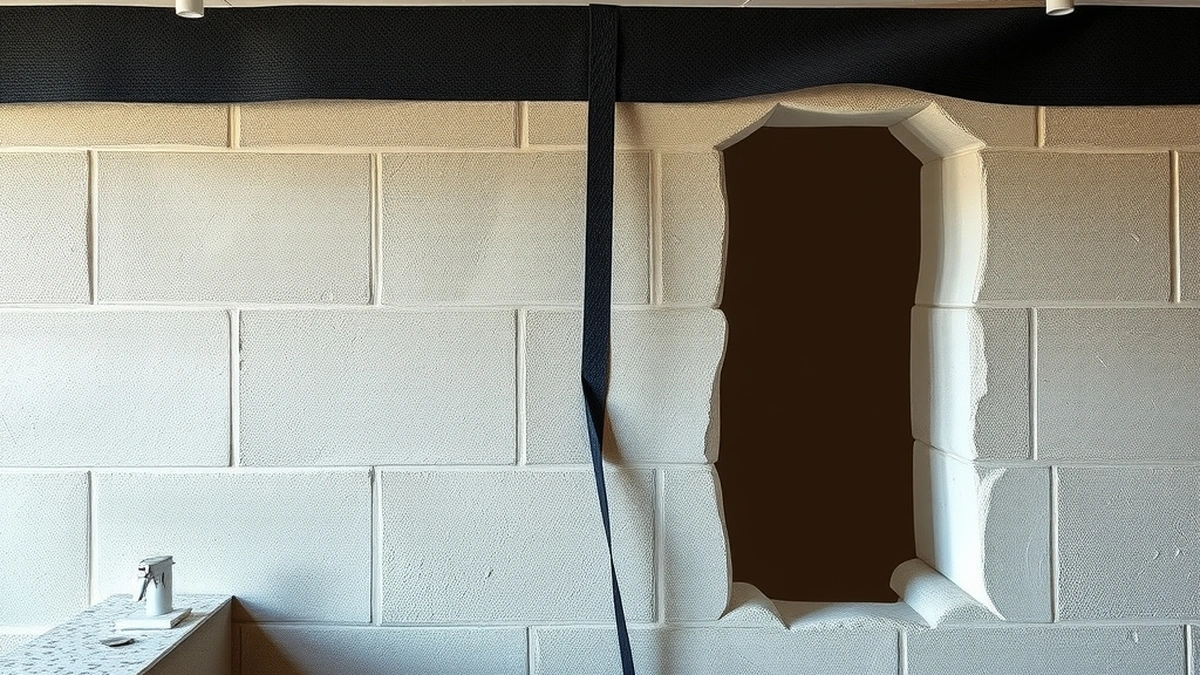
Carbon fibre straps work by bonding a high-strength strip to the inside face of a wall, anchored at the floor and rim, so it carries the tensile load that cracked the concrete. They cost $400 to $1,200 each.
- Cost per strap
- $400 - $1,200
- Strap spacing
- 4 - 6 feet on center
- Bond
- Structural epoxy
- Anchors
- Floor and rim
- Typical job
- $4,000 - $15,000
Some links on this page are affiliate links.If you buy through them we may earn a commission at no extra cost to you. We do not accept payment for rankings. Read the full disclosure.
Carbon fibre straps work by putting high-strength tension material where the wall has none. A narrow strip of carbon fibre is bonded vertically to the inside face of the wall and anchored at the floor and the rim. When soil pressure tries to bow the wall, the strap resists the tension that would otherwise crack the concrete or the mortar joints.
Why the Wall Needs Help
Concrete and block are strong in compression and weak in tension. A basement wall loaded from outside bends inward, and the inside face goes into tension. Masonry has almost no tensile strength, so it cracks at the mortar joints or through the block.
Steel rebar solves this in new construction. In an existing wall, the strap is the retrofit equivalent: it is placed on the tension face and bonded so it acts compositely with the wall. The composite action is the key word, because a strap that is merely attached rather than bonded carries nothing.
The Bond
The bond is the whole system. The strap is only as good as the epoxy connection between the carbon fibre and the concrete, and that connection depends on surface preparation.
The wall is ground to bare, sound concrete, dust is removed, and a structural epoxy is applied. The strap is pressed into the epoxy and rolled to remove voids. Any contaminant, paint, or loose material between the strap and the wall becomes a starting point for debonding.
The strap has to be anchored at both ends, because tension has to go somewhere. At the bottom, a bracket or plate is anchored to the floor or the footing. At the top, a plate is anchored to the rim joist or the floor diaphragm.
Without anchors, the strap would simply peel from the wall as the wall moved. The anchors transfer the load into the floor system, which is why the engineer checks the floor framing before specifying the strap.
Spacing and Count
| Wall length | Spacing | Straps |
|---|---|---|
| 12 feet | 6 feet | 3 |
| 20 feet | 5 feet | 4 |
| 30 feet | 5 feet | 6 |
| 40 feet | 4 feet | 10 |
The spacing comes from the engineer’s calculation, not from a rule of thumb. Tighter spacing is used where the wall is thinner, the soil pressure is higher, or the bow is greater.
A Costed Example
A 20-foot block wall with four straps at $850 each:
4 × $850 = $3,400
Add engineering at $900, crack injection at $600, and surface restoration at $800:
$3,400 + $900 + $600 + $800 = $5,700
That sits at the low end of the $4,000 to $15,000 band and reflects a short wall with moderate bowing.
The Installation Sequence
- Measure the bow and confirm the wall is out of plumb.
- Correct the water and soil pressure source.
- Grind the wall to bare concrete and remove dust.
- Apply structural epoxy and set the strap.
- Roll the strap to eliminate voids.
- Install the floor and rim anchors.
- Inject the cracks and restore the surface.
What Straps Cannot Do
Straps do not straighten a wall. A wall that has bowed 1.5 inches will still be bowed after the straps cure, because the strap resists further movement rather than reversing it.
They also do not work on a deteriorated wall. If the block or concrete has lost section, the epoxy has nothing sound to bond to and the strap will peel. In that case the wall section has to be rebuilt or the wall replaced.
And they do not address the water. A strap that holds a wall while the soil stays saturated is a repair that will be tested every wet season. Drainage correction belongs in the same scope.
Straps Versus Anchors
Anchors pull the wall outward toward plumb and can be tightened over time. Straps hold the wall where it is and add tensile capacity. A wall that is bowing but still structurally sound is a strap candidate; a wall under active pressure that needs to be pulled back is an anchor candidate. If the wall is already at 2 inches of bow, neither system restores it, and the conversation moves to straightening or replacement.
Many engineered repairs use both: anchors at the worst section and straps between them. The mix is a design decision, and the report should explain it.
What to Ask a Contractor
Ask how the surface will be prepared, what epoxy is specified, and how the anchors are embedded. Ask how many straps and at what spacing. Ask for the engineer’s calculation, not just the spacing, because the count is what the price is built from and the calculation is what justifies it. Ask whether crack injection is included, because a strap over an open crack is a strap over a leak.
Ask, too, what happens behind the strap after the job. In a finished basement the strap is usually covered with framing and drywall, and that restoration can add 20% to 50% to the project. A bid that prices the straps and ignores the wall finish is a bid that will grow before the basement is usable again.
For the cost detail, read what carbon fibre straps cost and carbon fibre versus wall anchors. If the wall is poured concrete under pressure, wall anchor cost is the closer comparison.
Frequently asked questions
How do carbon fibre straps strengthen a wall?
The strap is bonded to the wall face and anchored at the top and bottom. It carries tensile force across the crack, which the concrete or block cannot do on its own.
How many straps does a wall need?
Spacing is usually 4 to 6 feet on center, set by the engineer. A 20-foot wall at 5-foot spacing needs four straps.
Do carbon fibre straps stop a wall from bowing?
They stop further bowing by adding tensile capacity. They do not push a bowed wall back to plumb, which requires jacking or straightening.
How long do the straps last?
The carbon fibre and epoxy system is designed to last the life of the wall when the surface is properly prepared and the anchors are correctly installed.
Can straps be used on a poured wall?
Yes, though they are most common on block. Poured walls under active pressure often get anchors, which can be tightened as the load changes.
What voids a strap warranty?
Poor surface preparation, water intrusion behind the strap, and unaddressed soil pressure are common exclusions. Read the warranty before signing.
Sources
Some links are affiliate links.If you buy through them we may earn a commission at no extra cost to you. We do not accept payment for rankings. Read the full disclosure.