Water in the Crawl Space: Causes and Fixes
Standing water in a crawl space comes from grading, drainage, or groundwater. See the fixes, from $300 in downspout work to encapsulation.
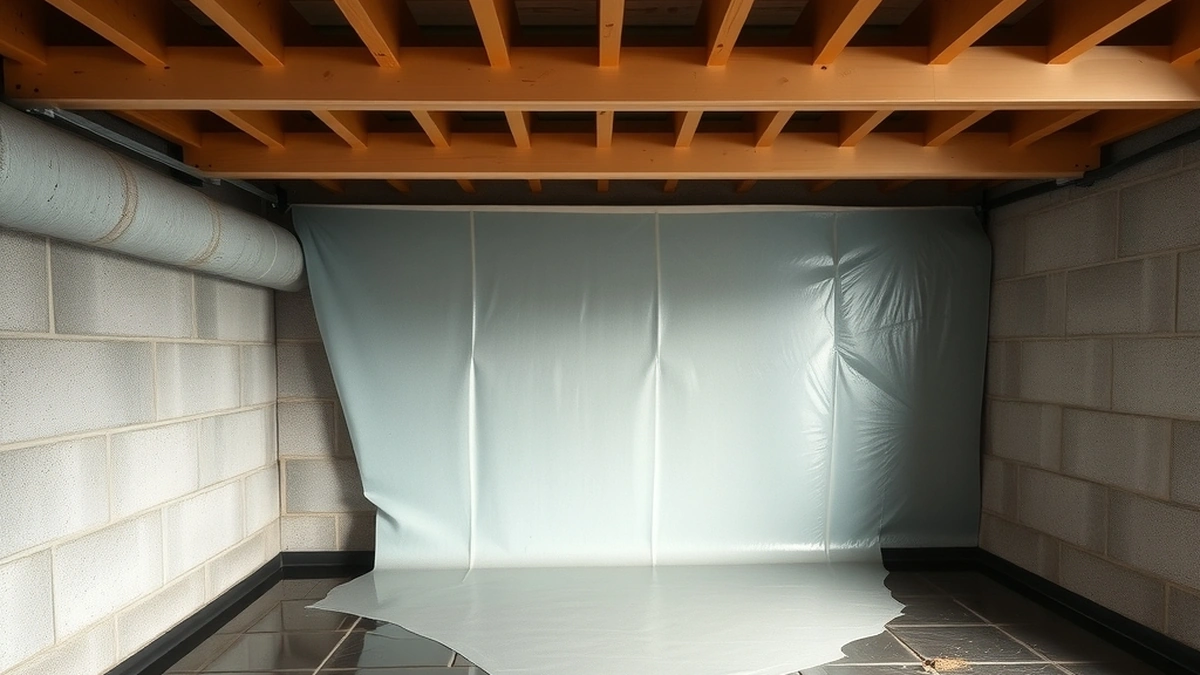
Water in a crawl space comes from surface runoff, failed grading, or a rising water table. Fix the source first, then control vapor with a sealed liner; encapsulation runs $4,000 to $15,000 for a typical house.
- Downspout and grading fix
- $300 - $4,000
- Encapsulation per sq ft
- $3 - $8
- Typical encapsulation job
- $4,000 - $15,000
- Dehumidifier
- $1,200 - $3,000 installed
- Crawl space humidity target
- Under 60% relative humidity
Some links on this page are affiliate links.If you buy through them we may earn a commission at no extra cost to you. We do not accept payment for rankings. Read the full disclosure.
Water in a crawl space comes from surface runoff, failed grading, or a rising water table, and the fix depends on which one you have. A wet crawl space after every storm is usually a drainage problem. Water that appears in dry weather is usually groundwater. Both need the source corrected before any liner is installed.
Why Crawl Space Water Matters
A crawl space is a cool, dark, poorly ventilated volume under the living space. Water in that volume raises humidity, and sustained humidity above roughly 60% creates conditions for mold, wood rot, and rust on hangers and ductwork. Floor joists lose strength as they absorb moisture, and the musty smell that follows travels upward into the house.
Water also changes the soil. Saturated soil expands and loses bearing capacity, which is why a chronic crawl space leak is often followed by cracked drywall and sticking doors a year or two later. The crawl space is the foundation’s environment, not a separate compartment.
Pests follow the water. Termites need moisture, and a damp crawl space with wood debris is close to an ideal habitat. Rodents and snakes use the same openings the water uses. Sealing the space and drying it removes the conditions both need, which is why encapsulation is often paired with a pest inspection rather than treated as a purely moisture-related job.
Four Sources, Four Fixes
| Source | Sign | Fix | Typical cost |
|---|---|---|---|
| Roof water at the wall | Wet band along one side after rain | Extend downspouts, clean gutters | $150 - $600 |
| Surface runoff | Water entering at the high side | Regrade to a 6-inch fall over 10 feet | $1,500 - $4,000 |
| High water table | Water in dry weather | Sump pit and pump, interior drain | $1,500 - $6,000 |
| Failed footing drain | Damp wall at the base, silt in the trench | Exterior drain replacement | $6,000 - $12,000 |
The order matters. Fixing the water table before fixing the downspouts means paying for a pump to handle water that should never have reached the house.
What Encapsulation Does and Does Not Do
Crawl space encapsulation is the installation of a sealed, heavy-duty liner over the soil and up the walls, with seams taped and penetrations sealed. It costs $3 to $8 per sq ft, and a typical 1,000 sq ft crawl space runs:
1,000 × $3 = $3,000 1,000 × $8 = $8,000
Add a dehumidifier at $1,200 to $3,000 installed, plus any drainage work, and the full project commonly lands between $4,000 and $15,000. What encapsulation does is stop soil moisture from evaporating into the crawl space air and stop humid air from moving upward into the house.
What it does not do is remove standing water. A liner laid over a puddle traps the water underneath and hides the problem while the soil stays saturated. Drain or pump the water first, then encapsulate.
The Sequence That Works
- Find the source. Watch the crawl space during and after a heavy rain and note where water first appears.
- Correct roof water and grading before anything else. This is the cheapest fix and the most common cause.
- If water rises from below, install a sump pit at the low point with a pump and a discharge that leaves the building.
- Remove any wet insulation, debris, and organic material, and dry the space.
- Install the liner from the soil up the walls, seal the seams, and seal around piers and penetrations.
- Add a dehumidifier sized to the volume and set it to hold humidity under 60%.
Sizing is simpler than it looks. Multiply floor area by ceiling height to get cubic feet, then look for a unit rated for that volume at the lowest expected temperature. A 1,000 sq ft crawl space with a 3-foot ceiling is 3,000 cubic feet, which a 70-pint unit handles comfortably. Oversizing wastes energy; undersizing runs continuously and never catches up.
Choosing Between Venting and Sealing
| Approach | Cost | Works in | Failure mode |
|---|---|---|---|
| Passive vents | Low | Dry, mild climates | Pulls humid air in |
| Powered vent | $300 - $900 | Shoulder seasons | Still introduces outside humidity |
| Sealed encapsulation | $4,000 - $15,000 | Most climates | Cost, and requires a working drain |
Venting was standard practice for decades, and it still works in parts of the Southwest where outside air is drier than the crawl space. In the Southeast, the Pacific Northwest, and most of the Midwest, venting pulls moist air into a cool space where it condenses on the joists. That is why sealed encapsulation has become the default recommendation in humid regions.
Cost of Waiting
A wet crawl space is not a cosmetic problem. Replacing rotted floor joists and subfloor in a 1,200 sq ft house can run $8,000 to $25,000, and mold remediation adds more. A sump pump and a liner at $5,000 to $10,000 is the cheaper path, and it protects the structural framing rather than repairing it later.
If the foundation has already moved, read foundation drainage cost for the exterior work and crawl space foundation repair cost for the structural side. For humidity control after the water is gone, see crawl space dehumidifier, and for the liner itself, crawl space vapor barrier.
Frequently asked questions
Is standing water in a crawl space an emergency?
It is urgent rather than an emergency. Water under the house rots joists, feeds mold, and attracts pests, so the source should be found and corrected within days, not months.
What causes water to pool in a crawl space?
Surface water running toward the foundation, downspouts discharging at the wall, a high water table, and missing or failed footing drains are the four common causes.
Will a vapor barrier stop standing water?
No. A vapor barrier controls moisture in the air and soil surface, but standing water has to be drained or pumped away first. A liner over a puddle just hides it.
How much does crawl space encapsulation cost?
Encapsulation runs $3 to $8 per sq ft, or roughly $4,000 to $15,000 for a typical house, including the liner, sealing, and often a dehumidifier.
Can I just ventilate the crawl space instead?
Venting works in some dry climates but often makes humid climates worse by pulling moist outside air into a cool space. Sealed encapsulation is the more reliable approach in most of the country.
Does water in the crawl space affect the foundation?
Yes. Saturated soil loses bearing capacity and expands, which can move footings and crack the structure above. Fixing the water protects the foundation as well as the floor framing.
Sources
Some links are affiliate links.If you buy through them we may earn a commission at no extra cost to you. We do not accept payment for rankings. Read the full disclosure.