Crawl Space Vapour Barrier: Spec and Cost
How to specify and price a crawl space vapour barrier, including thickness, coverage, encapsulation comparison, and labour estimates.
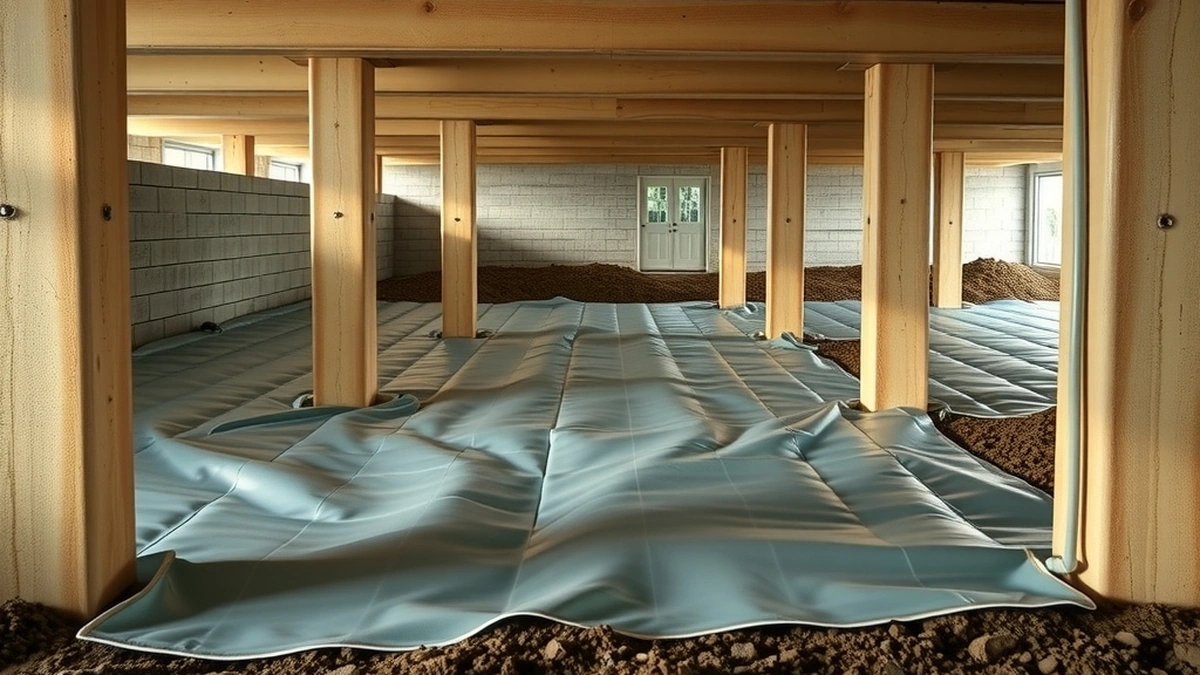
A crawl space vapour barrier is a polyethylene sheet laid over exposed soil to block ground moisture. Material typically runs $0.50 to $0.70 per square foot, while full professional encapsulation averages $3 to $8 per square foot or $4,000 to $15,000 per job.
- Typical material thickness
- 6 mil to 12 mil polyethylene
- Material cost (estimate)
- $0.50–$0.70 per sq ft
- Professional encapsulation (estimate)
- $3–$8 per sq ft; $4,000–$15,000 per job
- Engineer inspection
- $400–$1,500
Some links on this page are affiliate links.If you buy through them we may earn a commission at no extra cost to you. We do not accept payment for rankings. Read the full disclosure.
A crawl space vapour barrier is a continuous sheet of polyethylene placed over exposed soil to stop ground moisture from entering the structure. It is specified by thickness, overlap, and sealing detail, and priced by material grade and whether installation is DIY or professional. Measure the crawl space first, choose the membrane second, and price the job third.
What a Crawl Space Vapour Barrier Does
The soil beneath a house releases water vapour continuously. Without a membrane, that vapour rises into the crawl space, condenses on cooler framing, and raises the moisture content of joists, beams, and subflooring. A vapour barrier interrupts that path by creating an impermeable layer between the earth and the building envelope.
It is not a structural repair. If you observe sloping floors, stair-step cracks in masonry, or doors that no longer close, the issue may be foundation settlement rather than moisture. In those cases, start with an engineer inspection ($400–$1,500) and review repair options such as piering or slab lifting before spending money on moisture control. A vapour barrier manages humidity; it does not lift a settled foundation.
Specification: Thickness, Material, and Coverage
Vapour barriers are sold by mil thickness. One mil equals one-thousandth of an inch.
- 6 mil polyethylene: Minimum for light-duty coverage in low-traffic crawl spaces. Economical but tears easily during installation and future access.
- 10 mil to 12 mil reinforced polyethylene: Preferred for most residential work. Resists punctures and holds up to occasional crawling for plumbing or HVAC service.
- 15 mil to 20 mil reinforced: Used in encapsulated crawl spaces where the membrane is expected to serve as a durable, long-term surface.
Coverage must be continuous. The membrane should run from one side of the crawl space to the other, lap up the foundation wall or piers by at least 6 to 12 inches, and be sealed at seams with compatible tape or adhesive. Gaps around piers, plumbing penetrations, and support columns must be sealed or the barrier loses effectiveness.
Arithmetic example for material only: a crawl space measuring 40 feet by 25 feet equals 1,000 square feet. At $0.50 to $0.70 per square foot for 6-mil to 12-mil polyethylene, material cost is $500 to $700. Add seam tape, fasteners, and termination batts, and material-plus-accessories typically lands between $700 and $1,000 for that size.
Installation Method
Measure first. Record the footprint, pier locations, and any low spots where water pools. Standing water must be drained or the crawl space must be dried before membrane installation; trapping water under poly creates a stagnant, humid environment.
Prepare the soil by removing sharp rocks, roots, and debris that could puncture the membrane. Unroll the poly so seams run parallel to the longest dimension, overlapping seams by 6 to 12 inches. Seal seams with manufacturer-approved tape. Run the material up the perimeter wall or around piers and fasten it with termination strips or mastic. Cut and seal around penetrations such as plumbing traps and HVAC ducts.
Do not stretch the membrane tight. Leave slight slack to accommodate soil settlement and thermal movement without tearing at anchor points.
Vapour Barrier vs. Full Encapsulation
A vapour barrier covers the soil only. Full crawl space encapsulation seals the ground, walls, vents, and rim joist, and often conditions the space with a dehumidifier or supply-air connection. Encapsulation is the appropriate choice when the crawl space is used for storage, when humidity remains high after soil coverage alone, or when the home is in a climate with persistent moisture loads.
Canonical pricing for professional encapsulation is $3 to $8 per square foot, or $4,000 to $15,000 per job. For the same 1,000-square-foot crawl space, that is $3,000 to $8,000 based on square-foot pricing, consistent with the broader job range. A soil-only vapour barrier installed by a contractor typically costs less than encapsulation because it requires fewer materials, no wall sealing, and no conditioning equipment.
| Scope | Basis | Estimate (USD) |
|---|---|---|
| DIY vapour barrier material | 1,000 sq ft | $500–$1,000 |
| Contractor vapour barrier install | 1,000 sq ft | $1,500–$3,500 |
| Full encapsulation | 1,000 sq ft | $3,000–$8,000 |
| Full encapsulation | per job | $4,000–$15,000 |
These are estimates. Actual price depends on access, local labour rates, mould remediation, and whether existing insulation must be removed.
When a Vapour Barrier Is Not Enough
Moisture in a crawl space is sometimes a symptom, not the cause. Plumbing leaks, improper grading, clogged gutters, and high groundwater can all overwhelm a membrane. Fix the water source before installing poly. If the crawl space has structural issues such as rotted beams or settled piers, address those first. Related repair paths include pier-and-beam foundation work, push piers, helical piers, and wall anchors, each with independent pricing and warranty terms.
Cracks in interior drywall or exterior brick should be measured before any moisture work. A crack under 1/16 inch is generally cosmetic; at 1/8 inch it enters a watch range; movement beyond 2 inches warrants structural evaluation. A vapour barrier will not close a structural crack or stop foundation movement.
Cost Context and Related Repairs
Foundation repair pricing varies widely by method and region. Push piers cost $1,000 to $3,000 each; helical piers cost $700 to $2,500 each; a full pier job often runs $6,000 to $30,000. Slab lifting methods such as mudjacking ($3 to $8 per square foot) or poly foam ($5 to $15 per square foot) address settled slabs, not crawl space humidity. Carbon fibre straps ($400 to $1,200) and wall anchors ($500 to $1,500 each) address wall movement. None of these are substitutes for a vapour barrier, and none are required solely to install one.
Average foundation repair falls between $4,000 and $15,000, while major structural work can reach $20,000 to $40,000. Full replacement ranges from $40,000 to $150,000. A vapour barrier is a low-cost moisture control measure compared with structural intervention, but it should be sized to the actual problem, not sold as a catch-all.
Maintenance and Realistic Expectations
Inspect the barrier annually. Look for tears, displaced seams, and areas where soil has shifted and uncovered the membrane. Repair punctures with compatible tape and patch material. In encapsulated crawl spaces, check the dehumidifier and confirm that conditioned air is circulating as designed.
A vapour barrier reduces vapour transmission; it does not eliminate all humidity, nor does it repair existing wood rot or mould. Treat active mould and replace damaged framing before sealing the space. Permits vary by city and county and typically take 1 to 3 weeks where required. Inspection lead time is usually 1 to 2 weeks.
Measure the crawl space, specify the membrane thickness, and price the job before purchasing materials. A correctly installed vapour barrier is an inexpensive, effective moisture control layer when it is matched to the actual conditions beneath the house.
Next, compare foundation repair cost, pier and beam foundation repair cost, foundation crack repair cost before you commit.
Frequently asked questions
What is a crawl space vapour barrier?
A continuous polyethylene membrane installed over exposed soil in a crawl space to reduce water vapour migration from the ground into the structure.
How thick should the barrier be?
Six-mil poly is the common minimum for light-duty coverage; 10-mil to 12-mil reinforced polyethylene is preferred where the space is accessed or used for storage.
Is a vapour barrier the same as encapsulation?
No. A vapour barrier covers the soil only; encapsulation seals the walls, vents, and rim joist and usually includes a conditioned or dehumidified environment.
What does professional installation cost?
Estimates range from $3 to $8 per square foot, or roughly $4,000 to $15,000 per job, depending on crawl size, access, and prep work.
Do I need an engineer before installing a barrier?
Not for a barrier alone, but if you see foundation cracks, sagging floors, or wall movement, an engineer inspection ($400–$1,500) is the correct first step.
How long does installation take?
Most residential crawl spaces are completed in one to three days, assuming clear access and no standing water or mould remediation.
Sources
Some links are affiliate links.If you buy through them we may earn a commission at no extra cost to you. We do not accept payment for rankings. Read the full disclosure.