Price Foundation Repair: How Bids Are Built
A foundation repair price is pier count, depth, engineering, permits, and restoration added together. See how each line is calculated.
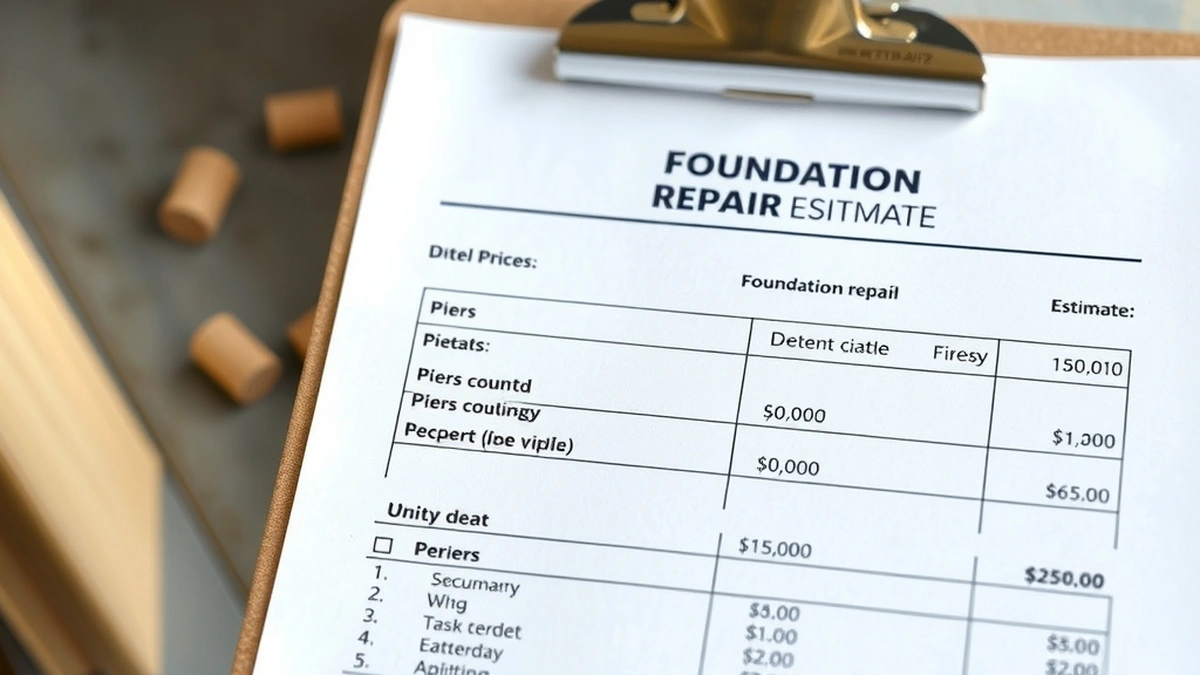
Foundation repair pricing is built from pier count times unit price, plus engineering at $400 to $1,500, permits, mobilization, and restoration at 10% to 25% of structural cost. Typical jobs land at $4,000 to $15,000.
- Typical total
- $4,000 - $15,000
- Pier unit price
- $700 - $3,000
- Engineering
- $400 - $1,500
- Restoration
- 10% - 25% of structural
- Warranty transfer
- $100 - $500
Some links on this page are affiliate links.If you buy through them we may earn a commission at no extra cost to you. We do not accept payment for rankings. Read the full disclosure.
Foundation repair price is built in layers: unit count, unit price, engineering, permits, mobilization, and restoration. Most totals land between $4,000 and $15,000, with major work at $20,000 to $40,000. If you can read the layers, you can compare bids honestly instead of comparing the last number on the page.
The Unit Price Layer
Every method has a unit. Push piers run $1,000 to $3,000 each. Helical piers run $700 to $2,500 each. Wall anchors run $500 to $1,500 each. Carbon fibre straps run $400 to $1,200 each. Crack injection runs $400 to $1,200 per crack. Slab lifting runs $3 to $12 per sq ft.
The unit price is where most homeowners focus, and it is the least important number in the bid. A contractor with a low unit price and a high count can be more expensive than one with a high unit price and a conservative count, and the second is often the better repair.
The Count Layer
The count comes from the engineer’s design. Pier spacing along a wall is typically 6 to 10 feet, with additional piers at corners and concentrated loads. A 40-foot wall at 8-foot spacing needs five piers, rounded up:
40 ÷ 8 = 5
If one bid says five and another says eight, the difference is not salesmanship; it is a different design assumption. Ask each contractor to justify the count against the engineer’s report.
The Overhead Layer
| Line item | Typical cost | Included? |
|---|---|---|
| Engineering report | $400 - $1,500 | Sometimes |
| Permit fee | $150 - $800 | Sometimes |
| Mobilization | $300 - $1,000 | Often hidden |
| Utility locate | $0 - $75 | Usually |
| Dumpster and disposal | $300 - $900 | Sometimes |
| Interior restoration | 10% - 25% of structural | Rarely |
Those six lines can add 20% to 40% to the headline number. A bid that omits them is not necessarily cheaper; it is less complete. The comparison that matters is the all-in total for the same scope.
A Full Price Build
A 1,900 sq ft house needs nine push piers. Here is the full build.
Piers: 9 × $2,000 = $18,000
Engineering: $1,000
Permit: $400
Mobilization: $600
Restoration at 15% of structural:
$18,000 × 0.15 = $2,700
Total: $18,000 + $1,000 + $400 + $600 + $2,700 = $22,700
That is a major repair, and it sits at the bottom of the $20,000 to $40,000 band. Note that restoration alone is 12% of the total, which is why it belongs in the budget from the start.
Price by Region
Labor rates and permit fees vary by state and metro, and soil conditions vary by lot. Expansive clay in Texas and Colorado often requires deeper piers than glacial till in the upper Midwest, and a deeper pier costs more steel and more driving time.
Coastal markets with high labor rates and tight access sit at the top of every band. Rural markets with cheap labor and easy access sit at the bottom. The same nine-pier scope can differ by 30% or more between two states, and neither price is wrong.
Season matters as well. A job priced in February for a March start often costs less than the same job priced in June for an August start, because crews are booking winter work at a discount and summer work at a premium. If the movement is not urgent, ask what the off-season price would be.
What a Low Bid Usually Omits
| Omission | Effect on the repair |
|---|---|
| Fewer piers | Wall may continue to settle between piers |
| Shallower design depth | Piers stop above competent soil |
| No engineering | No elevation survey, no lift tolerance |
| No permit | Inspection and resale problems |
| No restoration | Surprise cost after the lift |
| Shorter warranty | Less recourse if it moves again |
A bid that is 30% below the others will usually contain two or three of those omissions. Ask which ones, and price them back in before deciding.
How to Negotiate Scope
- Get the engineer’s report first and use it as the common scope.
- Ask each bidder to price the same unit count and depth.
- Ask what a lower bid excludes before asking for a discount.
- Negotiate payment terms and the overrun rate, which cost the contractor little.
- Ask whether non-critical areas can be staged over two seasons.
- Never trade away the pier count or the engineering to hit a budget.
Reading the Final Invoice
The final invoice should match the contract, with change orders documented and signed. Compare the pier count installed against the count billed, and confirm the refusal depths match the lift log. If the invoice includes extra piers, the change order should show the unit price agreed before excavation.
For the full estimating context, read foundation repair cost and how much foundation repair costs. If you are comparing bids from different firms, foundation repair contractors covers the contract terms that go with the price.
One final check belongs on every bid. Make sure the total is expressed in the same way across all of them: before tax or after, with permit included or excluded, and with restoration in or out. Two bids can look $3,000 apart and be identical once the presentation is normalised.
Frequently asked questions
How is foundation repair priced?
By the unit. Piers are priced each, anchors and straps are priced each, injection is priced per crack, and slab lifting is priced per square foot. The total is units times price plus overheads.
Why do foundation repair prices vary so much between contractors?
Because the scopes differ. Pier counts, design depths, engineering, permits, and restoration are often different, and those differences change the total far more than the unit price does.
What is a fair price for foundation repair?
A fair price is one that states the unit count, the design depth, the engineering, and the exclusions, and that lands within the $4,000 to $15,000 band for a typical job.
Should I negotiate foundation repair price?
You can negotiate scope more reliably than price. Ask what a lower bid omits, and ask whether the pier count can be staged. A discount with no scope change usually means a thinner repair.
Does the price include permits?
Not always. Permit fees and the contractor's time to pull them are sometimes a separate line. Ask explicitly, because an unpermitted structural repair can complicate a future sale.
How much should I pay up front?
A deposit under one third is normal. Hold the final 10% to 20% until the inspection is signed off and the lift record is delivered.
Sources
Some links are affiliate links.If you buy through them we may earn a commission at no extra cost to you. We do not accept payment for rankings. Read the full disclosure.