How Mudjacking Works: Slurry Lifting Explained
Mudjacking pumps a sand-cement slurry under a settled slab at $3 to $8 per sq ft. See the holes, the mix, the lift, and where it stops working.
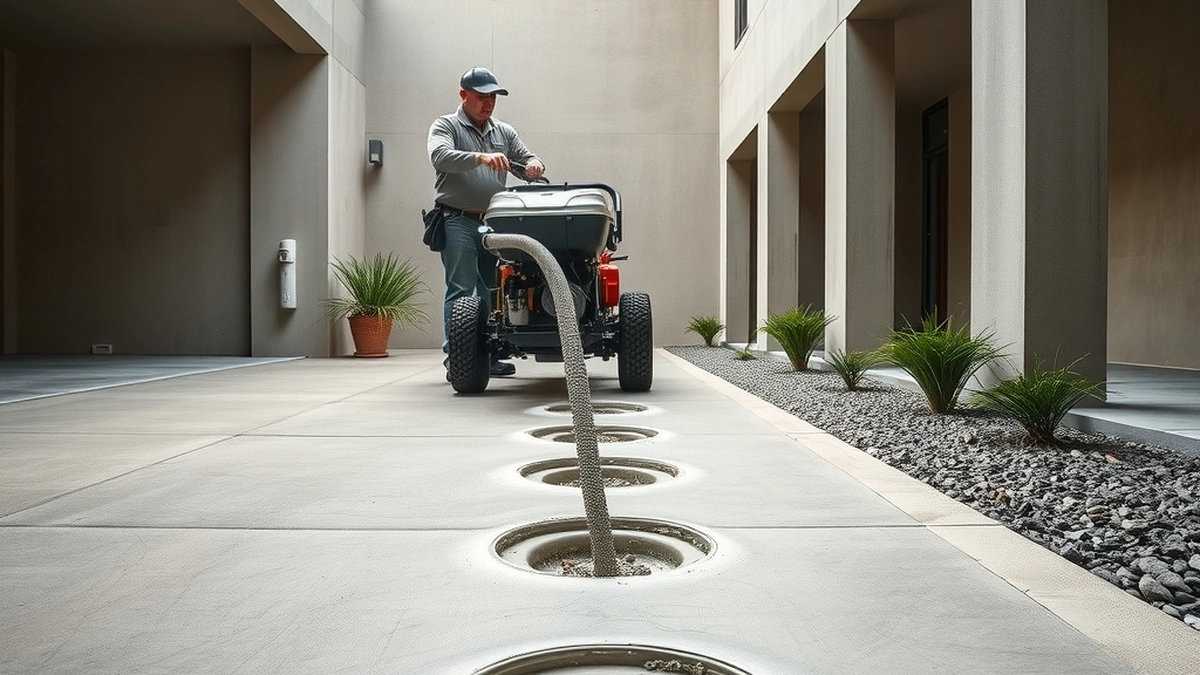
Mudjacking drills 1 to 2 inch holes through a settled slab and pumps a sand, cement, and water slurry underneath at $3 to $8 per sq ft. The slurry fills voids and lifts the concrete back toward grade.
- Cost per sq ft
- $3 - $8
- Hole diameter
- 1 - 2 inches
- Typical service life
- 5 - 15 years
- Polyurethane alternative
- $5 - $15 per sq ft
- Slab lifting range
- $3 - $12 per sq ft
Some links on this page are affiliate links.If you buy through them we may earn a commission at no extra cost to you. We do not accept payment for rankings. Read the full disclosure.
Mudjacking lifts a settled concrete slab by pumping a sand, cement, and water slurry through small holes drilled in the surface. The mix fills the voids underneath and raises the slab as pressure builds. It costs $3 to $8 per sq ft, and it works on flatwork rather than on house foundations.
The Method in One Sentence
Mudjacking is a slab-lifting technique in which a low-strength slurry is injected beneath existing concrete to fill voids and restore grade. The slurry is not structural concrete. It is a fill material that hardens enough to support a driveway, sidewalk, patio, or garage floor, and it is deliberately weaker than the slab so that future movement cracks the fill rather than the concrete.
That distinction explains both what the method can do and where it stops. A slab on grade carries light loads and can be supported by compacted fill. A house foundation carries thousands of pounds per linear foot and needs a pier that reaches bearing soil.
The Five Steps
- Map the settled areas with a level and mark the low spots against the surrounding grade.
- Drill 1 to 2 inch holes through the slab on a grid, typically 4 to 6 feet apart.
- Mix the slurry to the contractor’s specification, usually sand, Portland cement, and water with a small amount of bentonite for flow.
- Pump the mix through each hole in sequence, watching the slab rise against a level or laser target.
- Plug the holes with patching mortar, clean the joints, and let the slab cure before traffic.
The whole job for a two-car driveway usually takes half a day. Curing to foot traffic takes a few hours, and vehicle traffic is typically held for 24 hours.
What It Costs and Why
Pricing is by area, with a minimum charge that reflects mobilization. A 600 sq ft driveway at $5 per sq ft is:
600 × $5 = $3,000
A 120 sq ft walkway at the same rate is:
120 × $5 = $600
Small jobs often carry a minimum of $300 to $600 because the pump, mixer, and crew cost the same to mobilize whether the slab is 100 sq ft or 1,000 sq ft. That is why the per-foot price on a small stoop can look double the price on a driveway.
Mudjacking Versus Polyurethane
| Factor | Mudjacking | Polyurethane foam |
|---|---|---|
| Cost | $3 - $8 per sq ft | $5 - $15 per sq ft |
| Material weight | Heavy, roughly 100 lb per cubic ft | Light, roughly 3 to 6 lb per cubic ft |
| Cure time | 24 hours to traffic | 15 minutes to traffic |
| Hole size | 1 to 2 inches | 5/8 inch |
| Water resistance | Poor to moderate | Good |
The weight difference matters on soft soil. A slurry that weighs 100 lb per cubic ft adds load to the very soil that failed. Foam weighs a fraction of that, so it is preferred where the subgrade is weak or the slab is thin. On a stable subgrade under a driveway, mudjacking does the same job for less money.
Where Mudjacking Stops Working
Mudjacking does not fix water. If the slab settled because a downspout has been dumping at the corner for a decade, the slab will settle again once the new fill is saturated and washed out. Fix the drainage first, or the lift is temporary.
It also does not fix a slab that is structurally broken. Concrete that is cracked into several pieces and moving independently needs replacement, not lifting, because the pieces will not rise as one plane. And it does not fix a house foundation, a retaining wall, or a pool deck that has moved because the soil beneath it is failing at depth.
There is a middle case worth knowing. A garage floor that has settled 2 inches but is otherwise sound is a good candidate, while a driveway that has settled 4 inches against the garage apron usually needs the apron replaced after the lift because the joint can no longer be brought back into line. Walk the slab with a 4-foot level and mark every point where the gap exceeds a quarter inch; that map tells the contractor more than any description over the phone.
For slabs that are too far gone, slab lifting methods covers replacement and overlay options, and concrete foundation repair explains when the problem has moved from flatwork into structure.
Reading the Warning Signs
- A crack at 1/16 inch is usually cosmetic.
- A crack at 1/8 inch should be measured and monitored.
- Movement of 2 inches or more in a foundation wall is a structural issue, not a slab issue.
- More than 33% of a foundation failed points toward replacement, not lifting.
Those thresholds come from foundation work and are useful here because homeowners often confuse slab settlement with structural settlement. If the doors in the house stick and the drywall cracks at the corners, the problem is below the footing, not below the driveway.
Choosing a Contractor
Ask what the slurry mix is, how much lift is targeted, and what the warranty covers. A one-year warranty on workmanship is common; a lifetime warranty on mudjacking is not, because the material has a service life of 5 to 15 years.
Ask, too, whether the contractor will drill a post-tension slab. If the answer is yes without a cable scan, find another contractor. For the broader comparison, read mudjacking cost and piers versus mudjacking before you decide the slab is the only thing that needs lifting.
Frequently asked questions
How does mudjacking lift concrete?
A slurry of sand, cement, and water is pumped through small holes drilled in the slab. Pressure forces the mix into voids and under the concrete, raising it as the material fills the space.
How much does mudjacking cost?
Most jobs run $3 to $8 per sq ft. A 600 sq ft driveway at $5 per sq ft is $3,000, and small stoops and walks often carry a minimum charge of $300 to $600.
How long does mudjacking last?
Expect 5 to 15 years depending on drainage, soil, and traffic. Slabs that keep settling usually have a water problem that mudjacking does not fix.
Can mudjacking lift a house foundation?
No. Mudjacking lifts slabs and shallow flatwork. Structural settlement of a house requires piers driven to bearing soil, which is a different method at a different price.
Does mudjacking work on a frozen slab?
No. The slurry needs unfrozen ground and temperatures above freezing to cure. Winter work is usually postponed unless the slab is indoors and heated.
Is polyurethane better than mudjacking?
Polyurethane is lighter, cures faster, and resists water better, but it costs $5 to $15 per sq ft against $3 to $8. For a settled driveway, mudjacking is usually the cheaper answer.
Sources
Some links are affiliate links.If you buy through them we may earn a commission at no extra cost to you. We do not accept payment for rankings. Read the full disclosure.