Polyurethane Foam Lifting Explained: Costs and Process
How polyurethane foam lifting works for slab foundations, typical costs per square foot, and how it compares to mudjacking and piers.
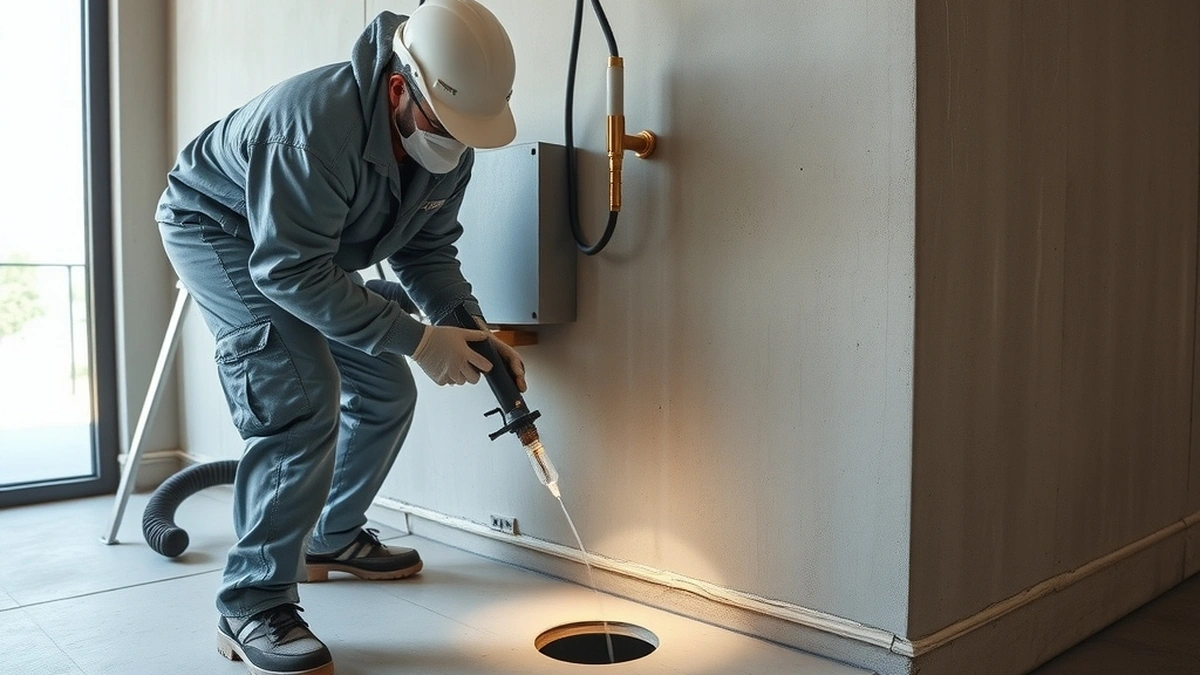
Polyurethane foam lifting injects expanding foam under settled concrete slabs to raise them, typically costing $5 to $15 per square foot.
- Typical cost range
- $5–$15 per square foot
- Common job size
- 100–500 square feet
- Estimated job total
- $500–$7,500
- Cure time before use
- 15–30 minutes
- Expected service life
- 10–20 years (estimate)
Some links on this page are affiliate links.If you buy through them we may earn a commission at no extra cost to you. We do not accept payment for rankings. Read the full disclosure.
Polyurethane foam lifting is a method for raising settled concrete slabs by injecting expanding foam beneath them. The foam fills voids, compacts loose soil, and lifts the slab through small drilled ports. It is commonly used for driveways, garage floors, interior slabs, and porch sections that have dropped due to soil washout or poor compaction.
How Polyurethane Foam Lifting Works
A contractor drills small holes, usually 5/8 inch to 1 inch in diameter, through the concrete at strategic points. A two-part polyurethane mixture is injected through the ports. The components mix at the tip of the injection gun, expand rapidly, and exert upward pressure on the slab while filling voids underneath.
Crews monitor lift with a level or laser. Once the slab reaches the target elevation, the ports are patched with cementitious grout. The foam cures quickly, often within 15 to 30 minutes, so the slab can bear light foot traffic almost immediately.
This is not a structural foundation repair for bearing walls or footings. It addresses slab settlement and void filling. If the problem involves a foundation wall moving inward or a footing that has lost bearing, piers or wall anchors are the appropriate measurement-first response.
Typical Costs and Arithmetic
Polyurethane foam lifting is priced by square foot of treated area. The standard range is $5 to $15 per square foot.
Example calculation for a 20-foot by 25-foot garage slab:
- Area: 20 ft × 25 ft = 500 sq ft
- Low estimate: 500 sq ft × $5 = $2,500
- High estimate: 500 sq ft × $15 = $7,500
For a smaller 10-foot by 12-foot porch section:
- Area: 10 ft × 12 ft = 120 sq ft
- Low estimate: 120 sq ft × $5 = $600
- High estimate: 120 sq ft × $15 = $1,800
These are estimates. Final price depends on foam density, depth of injection, number of ports, access restrictions, and regional labor rates. Minimum trip charges may apply for small jobs.
For comparison, mudjacking runs $3 to $8 per square foot but uses a heavier cement slurry and larger 1- to 2-inch holes. Push piers cost $1,000 to $3,000 each, and helical piers cost $700 to $2,500 each, with full pier jobs typically landing between $6,000 and $30,000. Foam lifting is generally less invasive than piers, but it does not transfer load to deep bearing strata.
When Foam Lifting Is Appropriate
Foam lifting fits slabs that have settled evenly or locally without major structural distress. Common scenarios include:
- Garage floors sloping toward the door
- Driveway slabs tilted at the street
- Interior basement slabs with minor dip
- Pool decks and patio sections with trip hazards
Measure first: crack width and vertical displacement matter. A crack under 1/16 inch is generally cosmetic. A crack at or above 1/8 inch warrants monitoring and possibly structural evaluation. If a wall has moved more than 2 inches, or if a slab is part of a structural foundation system rather than a non-structural topping, foam alone is likely insufficient.
Foam does not replace failed footings. If more than one-third of the support system has failed, replacement or full underpinning may be indicated rather than spot lifting.
Foam Lifting vs. Mudjacking
Both methods lift slabs, but they differ in material, hole size, and cure time.
| Factor | Polyurethane Foam | Mudjacking |
|---|---|---|
| Cost per sq ft | $5–$15 | $3–$8 |
| Injection hole size | 5/8–1 inch | 1–2 inches |
| Material weight | Light | Heavy cement slurry |
| Cure time | 15–30 minutes | 24–72 hours |
| Typical life estimate | 10–20 years | 5–15 years |
Mudjacking is cheaper per square foot, but the slurry adds weight to already weak soil. Foam is lighter and cures faster, which matters when a garage or driveway must return to service quickly. Neither method addresses bearing capacity beneath a foundation wall.
Limitations and What Foam Cannot Do
Foam lifting does not:
- Repair structural cracks in foundation walls
- Stabilize a bowing basement wall
- Replace failed piers or footings
- Fix drainage problems that caused the settlement
If water is actively washing soil from under the slab, foam may provide a temporary lift but the underlying drainage issue must be corrected first. Otherwise, the slab can settle again.
For foundation wall cracks, carbon fiber straps ($400 to $1,200) or wall anchors ($500 to $1,500 each) are common alternatives. For deeper settlement under load-bearing elements, push or helical piers transfer the structure to competent soil.
Choosing a Contractor and Permits
Ask for a written scope that lists square footage, estimated foam pounds, port locations, and lift targets. Request a post-lift measurement showing the slab is within acceptable tolerance. Confirm whether the foam is structural-grade or void-fill grade, and ask about any warranty on lift retention.
Permit requirements vary by city and county and typically take 1 to 3 weeks. Some jurisdictions treat slab lifting as minor work; others require a permit if structural elements are involved. Check with the local building department before scheduling.
An engineer inspection, if needed, costs $400 to $1,500 and usually has a lead time of 1 to 2 weeks. For context, average foundation repair jobs range from $4,000 to $15,000, while major repairs can reach $20,000 to $40,000. Full replacement runs $40,000 to $150,000.
Related Repair Costs
If your settlement issue extends beyond a slab, compare these estimate ranges:
- Push pier: $1,000 to $3,000 each
- Helical pier: $700 to $2,500 each
- Full pier job: $6,000 to $30,000
- Mudjacking: $3 to $8 per square foot
- Carbon fiber strap: $400 to $1,200
- Wall anchor: $500 to $1,500 each
For more detail on slab and foundation pricing, see the foundation repair cost overview, mudjacking cost breakdown, and pier cost comparison.
Polyurethane foam lifting is a measured, numbers-first option for settled slabs when the issue is void loss rather than structural bearing failure. Measure the crack width, record the displacement, calculate the square footage, and compare the cost per square foot against piers or mudjacking before choosing a method.
Frequently asked questions
What is polyurethane foam lifting?
Polyurethane foam lifting is a slab repair method where expanding two-part foam is injected through small holes in settled concrete to fill voids and lift the slab back toward level.
How much does polyurethane foam lifting cost?
Expect roughly $5 to $15 per square foot, so a 200-square-foot section often runs about $1,000 to $3,000 depending on access, depth, and local labor rates.
Is foam lifting better than mudjacking?
Foam uses smaller injection holes and cures faster, while mudjacking costs $3 to $8 per square foot but uses heavier cement slurry and typically takes longer to cure.
How long does polyurethane foam last?
Manufacturer and contractor estimates commonly cite 10 to 20 years, though actual longevity depends on soil conditions, drainage, and slab loading.
Can foam lifting fix foundation cracks?
It can re-level a slab that has settled, but it does not repair structural cracks in foundation walls; crack repair or piers may be needed instead.
Do I need a permit for foam lifting?
Permit requirements vary by city and county and typically take 1 to 3 weeks; check with your local building department before scheduling work.
Sources
Some links are affiliate links.If you buy through them we may earn a commission at no extra cost to you. We do not accept payment for rankings. Read the full disclosure.