Helical Piers for Foundation Repair: How They Work
Helical piers are rotated into soil to a torque target and cost $700 to $2,500 each. See capacity, installation, and where they beat push piers.
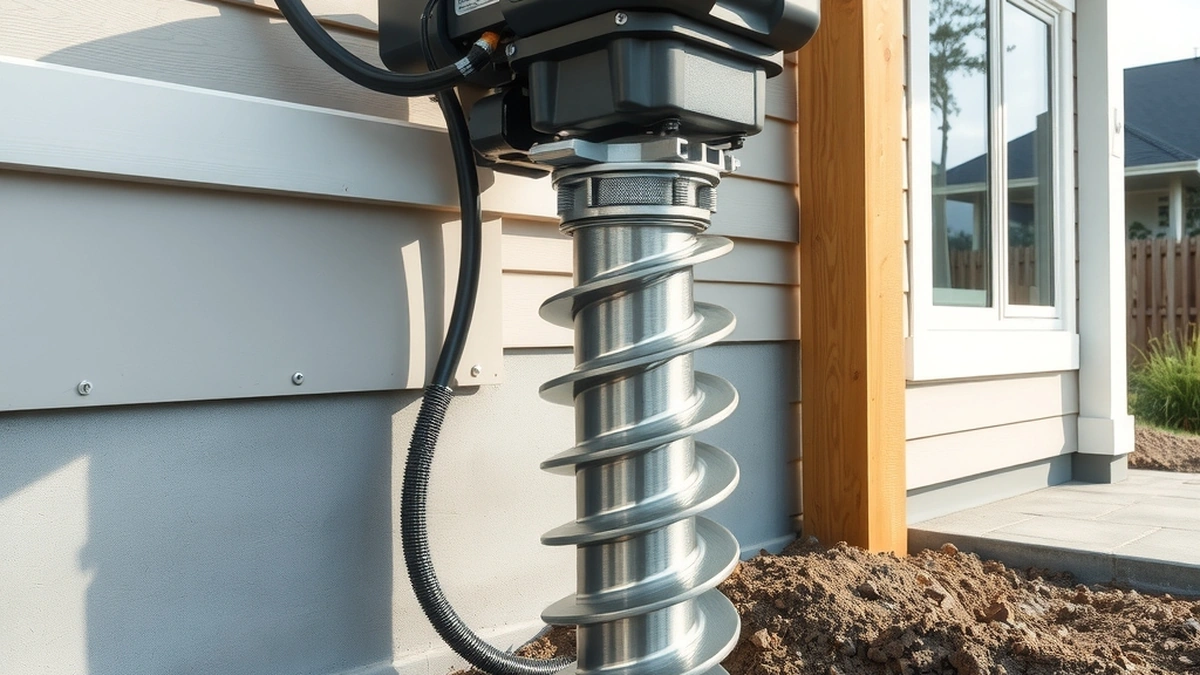
Helical piers are steel shafts with helical plates rotated into soil until a specified torque confirms capacity. They cost $700 to $2,500 each, install with lighter equipment than push piers, and suit lighter structures and tight access.
- Cost per pier
- $700 - $2,500
- Typical job
- $6,000 - $30,000
- Installation method
- Rotated to torque
- Load verification
- Torque reading
- Best for
- Lighter loads, tight access
Some links on this page are affiliate links.If you buy through them we may earn a commission at no extra cost to you. We do not accept payment for rankings. Read the full disclosure.
Helical piers are steel shafts with helical plates that are rotated into the ground until torque confirms they have reached soil strong enough to carry the load. They cost $700 to $2,500 each, and a full job commonly runs $6,000 to $30,000. They suit lighter structures, tight access, and sites where a push pier rig cannot operate.
What a Helical Pier Is
A helical pier is a foundation support consisting of a steel shaft with one or more helical plates welded near the lead end. It is advanced into the soil by rotation rather than by driving, and the torque required to turn it is recorded as a measure of soil resistance.
That torque reading is the installation’s proof of capacity. The engineer specifies a torque value, the installer stops when it is reached, and the reading is logged. Unlike a driven pile, the pier does not need to hit refusal; it needs to reach the specified torque at the specified depth.
How Installation Runs
The crew exposes the footing, bolts a bracket to it, and positions the torque motor. The first section is advanced, then extensions are added as the pier goes deeper. Each section is coupled with a bolted or welded connection, and the torque is monitored continuously.
When the target torque is reached, the pier is cut to length, the bracket is loaded, and the lift proceeds in the same way as any other pier system. A typical residential pier goes 15 to 30 feet, and the whole installation for one pier takes 30 to 90 minutes depending on soil.
Cost and Job Arithmetic
| Item | Cost | Notes |
|---|---|---|
| Helical pier | $700 - $2,500 | Varies with depth and capacity |
| Bracket | Included usually | Confirm in the quote |
| Engineering | $400 - $1,500 | Design and torque specification |
| Permit | $150 - $800 | Varies by jurisdiction |
A job with eight helical piers at $1,400 each:
8 × $1,400 = $11,200
Add engineering at $900 and a permit at $300:
$11,200 + $900 + $300 = $12,400
That sits inside the $6,000 to $30,000 band and is typical for a single-wall repair on a light-frame house.
Helical Versus Push Piers
| Factor | Helical piers | Push piers |
|---|---|---|
| Installation | Rotated to torque | Driven to refusal |
| Equipment | Smaller, more portable | Heavy hydraulic rig |
| Capacity proof | Torque reading | Refusal pressure |
| Best structure | Lighter, frame | Heavier, masonry |
| Access | Tight spaces | Needs machine access |
| Cost each | $700 - $2,500 | $1,000 - $3,000 |
Push piers are the default for a heavy house on a site with access, because refusal is an unambiguous end point. Helical piers are the default when the rig cannot get to the wall, when the structure is light, or when the soil is consistent enough that torque is a reliable proxy for capacity.
Where Helical Piers Fit Best
They are common on decks, porches, additions, and light-frame houses where the loads are lower and the pier count is modest. They are also used to stabilize retaining walls and to support new construction on sites with poor surface soils.
They are less suitable where the soil contains large obstructions, because the plate can strike a boulder and deflect. They are also less suitable where corrosion is aggressive, such as some coastal or fill sites, unless the pier is galvanized or coated for that environment.
Ask for the torque log. It should show the final torque for each pier and the depth at which it was reached. A log that shows every pier at exactly the same torque and depth is suspicious; real soil varies, and the readings should vary with it. Ask, too, for the engineer’s torque specification and the correlation used to convert torque into capacity, because that correlation is soil-dependent and a reputable installer will have it documented rather than asserted.
A Costed Repair
A 1,300 sq ft cottage has settled along a 32-foot wall. The engineer specifies helical piers at 8-foot spacing:
32 ÷ 8 = 4 piers
At $1,600 each:
4 × $1,600 = $6,400
Add engineering at $800 and interior restoration at 10% to 25%:
$6,400 × 0.10 = $640 $6,400 × 0.25 = $1,600
All-in: $7,840 to $8,800. That is a small job at the bottom of the full range, which is typical for a light house with one affected wall.
The Installation Sequence
- Get an engineer’s design with pier capacity, torque, and spacing.
- Confirm the permit and the utility locate.
- Excavate to the footing and bolt the bracket.
- Advance the pier sections, recording torque at each stage.
- Reach the specified torque and depth, then cut and load the pier.
- Lift to tolerance, lock off, and backfill.
- Record the torque log and hand it to the homeowner.
When to Choose Something Else
If the house is heavy masonry and the site has access, push piers are usually the better value. If the movement is lateral rather than vertical, neither pier type is the answer, and anchors or straps are. If the soil is so poor that neither system reaches capacity, a different foundation solution may be required.
For the comparison, read push piers versus helical piers and helical pier cost. If the movement is a bowing wall rather than settlement, wall anchors explained covers the correct repair.
Frequently asked questions
How much do helical piers cost?
Helical piers run $700 to $2,500 each installed. Most houses need several, so a full job commonly lands between $6,000 and $30,000 including engineering.
How do helical piers work?
A steel shaft with one or more helical plates is rotated into the ground by a torque motor. Installation stops when the torque reaches the value the engineer specified, which correlates with soil capacity.
Are helical piers as strong as push piers?
Both reach competent soil, but push piers are driven to refusal and suit heavier structures. Helical piers are load-tested by torque and are often used for lighter loads or where access is limited.
Can helical piers be installed in tight spaces?
Yes. The equipment is smaller than a push pier rig, which makes helical piers practical in backyards with no machine access, on interior slabs, and against walls with limited clearance.
How long do helical piers last?
Hot-dip galvanized helical piers are designed for a service life of decades in most soils. Corrosive soils may require a protective coating or a different system.
Do helical piers need a permit?
Structural underpinning usually requires a permit, and the engineer's design is part of the application. Ask the contractor who is pulling it and when the inspection is scheduled.
Sources
Some links are affiliate links.If you buy through them we may earn a commission at no extra cost to you. We do not accept payment for rankings. Read the full disclosure.