What Helical Piers Costs: Price Guide
Find out what helical piers cost and how to budget for pier repair. Independent estimates from Foundation Repair Lab.
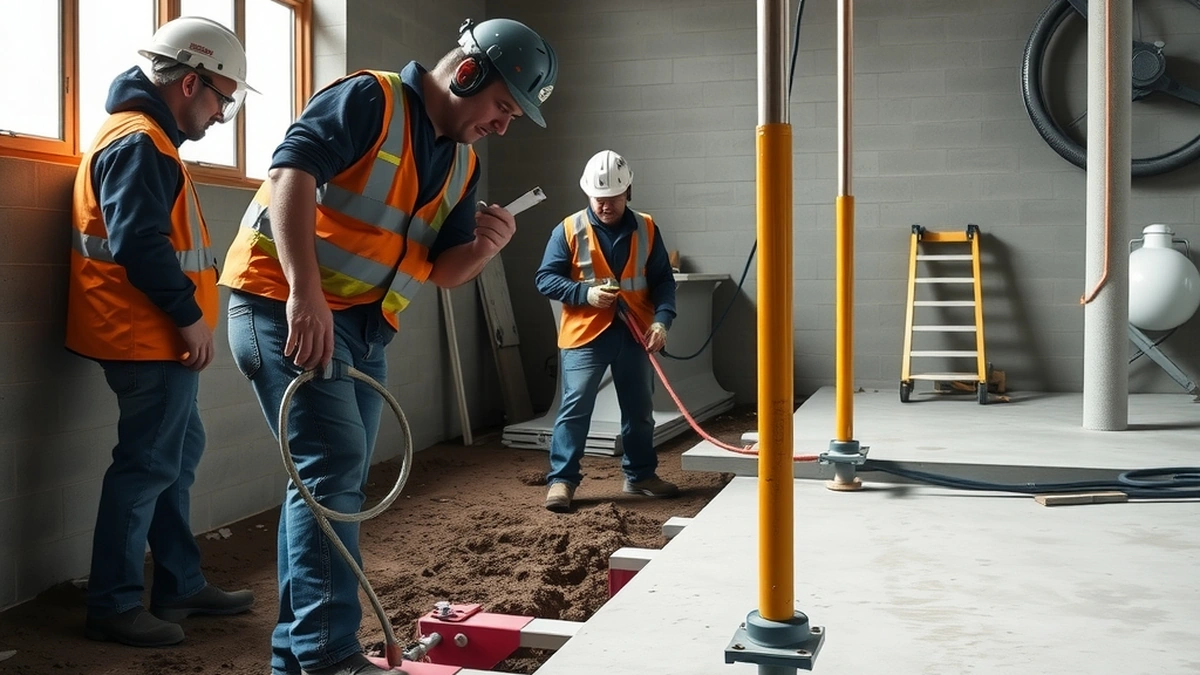
The cost of helical piers ranges from $700 to $2,500 per pier, with a typical job costing between $6,000 and $30,000 depending on pier count, depth to bearing, and displacement. Prices vary based on your home's square footage and structural damage.
- Typical range
- Varies by system and site
- First step
- Measure the space and confirm the load
- Professional help
- Recommended for structural or electrical work
Some links on this page are affiliate links.If you buy through them we may earn a commission at no extra cost to you. We do not accept payment for rankings. Read the full disclosure.
Helical piers cost $700 to $2,500 per pier installed, and most residential jobs total $6,000 to $30,000. The unit price is set by shaft diameter, plate size, and the capacity the design requires. The job total is set by how many piers the engineered plan calls for and how deep each one has to travel to reach bearing soil.
A helical pier is a steel shaft with one or more helical plates that is rotated into the ground until torque confirms it is bearing on competent soil, then bracketed to the footing so the foundation load is carried on that deeper stratum.
What the Per-Pier Price Covers
Each pier is a discrete structural element: shaft sections, one or more plates, a top bracket that ties into the footing, and the machine time to drive it.
The $700 bottom of the range is a short pier in easy soil with a light load, installed with a compact machine and no obstructions. The $2,500 top is a deep pier with a larger shaft and plate, installed through fill or debris soil, in a crawl space where the equipment has to be taken apart to get in. Most residential work sits between those extremes.
The Numbers to Plan With
- $700 to $2,500 per helical pier, installed.
- $1,000 to $3,000 per push pier, for the direct comparison.
- $6,000 to $30,000 for a typical pier job.
- $400 to $1,500 for an engineer inspection.
- 1 to 2 weeks of lead time for that inspection.
- 1 to 3 weeks for permit processing.
- Lifetime, transferable warranty on pier systems, with a $100 to $500 transfer fee.
- 2 inches of wall movement, the usual threshold where piers are specified rather than monitored.
Those are planning figures from published US price ranges, not a bid.
Building a Job Total From the Unit Price
The unit price is the wrong number to budget from, because a pier job has a floor: mobilization, engineering, and patching do not shrink with the pier count.
Six piers at $700 is $4,200 in pier work. Add a $1,200 engineer inspection and $900 of concrete patching and the job is $6,300, which is the bottom of the $6,000 to $30,000 range. Eight piers at $1,200 is $9,600; with $800 of engineering and $700 of patching the total is $11,100. Twelve piers at $1,800 is $21,600; with $1,200 of engineering and $900 of patching the total is $23,700.
The pier count drives the total far more than the unit price does. A contractor quoting $1,000 per pier for fourteen piers is selling $14,000 of pier work inside a larger job, while one quoting $1,900 for seven is selling $13,300 — the totals look similar and the designs are not.
Helical Piers vs Push Piers
| Helical pier | Push pier | |
|---|---|---|
| Installation | Rotated in with torque | Driven down hydraulically |
| Reaction | Soil friction and plate bearing | Weight of the structure |
| Typical unit price | $700 to $2,500 | $1,000 to $3,000 |
| Suited to | Unknown fill, light structures, tension loads | Heavy structures, known bearing depth |
| Load verified by | Torque reading during installation | Hydraulic gauge pressure |
| Surface disturbance | Moderate | Low |
A helical pier is screwed in and the installation torque is recorded, so capacity is verified as it goes. A push pier uses the building’s own weight as reaction and is driven until it stops moving.
On unit price alone, helical piers are often the less expensive of the two. On job price, the design decides. Our push piers vs helical piers comparison goes deeper, and how do push piers work explains the reaction principle.
Depth, Capacity, and Access
Depth to bearing is the largest variable inside the per-pier range. If competent soil is 10 feet down, a pier needs two or three shaft sections and a short drive. If it is 25 feet down, the pier needs five or six sections, more torque time, and a larger machine.
Capacity works the same way. A 2-7/8-inch shaft with a 10-inch plate carries a different load than a 3-1/2-inch shaft with a 14-inch plate. The engineer sizes the pier to the load the footing actually carries, which is why two houses on one street can differ.
Access is the quiet cost. An exterior installation with a machine that can reach the wall is fast; a crawl space where the equipment has to be carried through a 30-inch door is not, and that labor sits inside the per-pier price.
Inspection, Permits, and Warranty
Most pier work starts with an engineer inspection costing $400 to $1,500, scheduled 1 to 2 weeks out. The engineer measures the movement, identifies the bearing stratum, and specifies pier locations, spacing, and depth. That document is what the contractor prices.
Permits vary by city and county and typically take 1 to 3 weeks. Some jurisdictions want stamped drawings; others accept the contractor’s design. Build the timeline into the schedule before you sign, because a crew that arrives before the permit is issued can leave you with an inspection problem at resale.
Pier warranties are typically lifetime and transferable. The transfer usually carries a $100 to $500 fee, and the warranty commonly excludes movement caused by drainage that was never corrected. Read the exclusions before treating the warranty as a resale asset; transferable foundation warranty covers what actually transfers.
When Piers Stop Being the Answer
Piers stabilize, and with lifting they restore part of the elevation. They do not rebuild a wall that has cracked through, and they are not economic when a large share of the foundation has failed. Two thresholds usually mark the change: 2 inches of wall movement, which generally means more than piers, and roughly one-third of the foundation compromised, which is where replacement starts being compared against repair.
Replacement runs $40,000 to $150,000. A pier job at $6,000 to $30,000 is a fraction of that, which is why underpinning is attempted first when the structure is otherwise sound. The decision point is condition, not price. Our guide to foundation repair cost puts the ranges side by side.
Pricing Your Own Job
- Measure the visible movement — crack width, floor slope, and door and window binding — and write the numbers down with dates.
- Book an independent engineer inspection at $400 to $1,500 and ask for a pier count, spacing, and depth in the report.
- Send the same report to three contractors and require each quote to state pier count, unit price, depth allowance, and what happens if refusal comes early.
- Divide each total by its pier count to compare all-in cost per pier, then check that the count matches the design.
- Confirm permit responsibility, warranty terms, and the transfer fee before signing.
The pier count and the depth allowance are the two numbers that decide whether a quote is real. Everything else is finishing work around them.
Frequently asked questions
How much does a helical pier cost per unit?
A single helical pier typically costs between $700 and $2,500, depending on the steel gauge, length, and load requirements.
What is the total cost for a typical pier job?
A standard pier job ranges from $6,000 to $30,000, based on the number of piers needed, depth to bearing, and house square footage.
How long does a helical pier job take?
Installation usually takes 1 to 2 days per pier, but total project timelines depend on the number of piers required and permit processing time of 1-3 weeks.
Does a pier job require permits?
Yes, most jurisdictions require a building permit for pier installation, which can take 1 to 3 weeks to process depending on city and county.
Is there an engineer inspection fee?
An independent engineer inspection is highly recommended and typically costs between $400 and $1,500 to verify structural load requirements and pier adequacy.
What is the warranty on helical piers?
Helical pier warranties are generally lifetime and transferable, meaning you can pass the protection down to future homeowners if you sell the property.
Sources
Some links are affiliate links.If you buy through them we may earn a commission at no extra cost to you. We do not accept payment for rankings. Read the full disclosure.