French Drain Problems: Clogs, Slopes, and Failures
French drains fail from silt, flat pipe, wrong stone, and bad discharge. See how to diagnose a failing drain and what a rebuild costs.
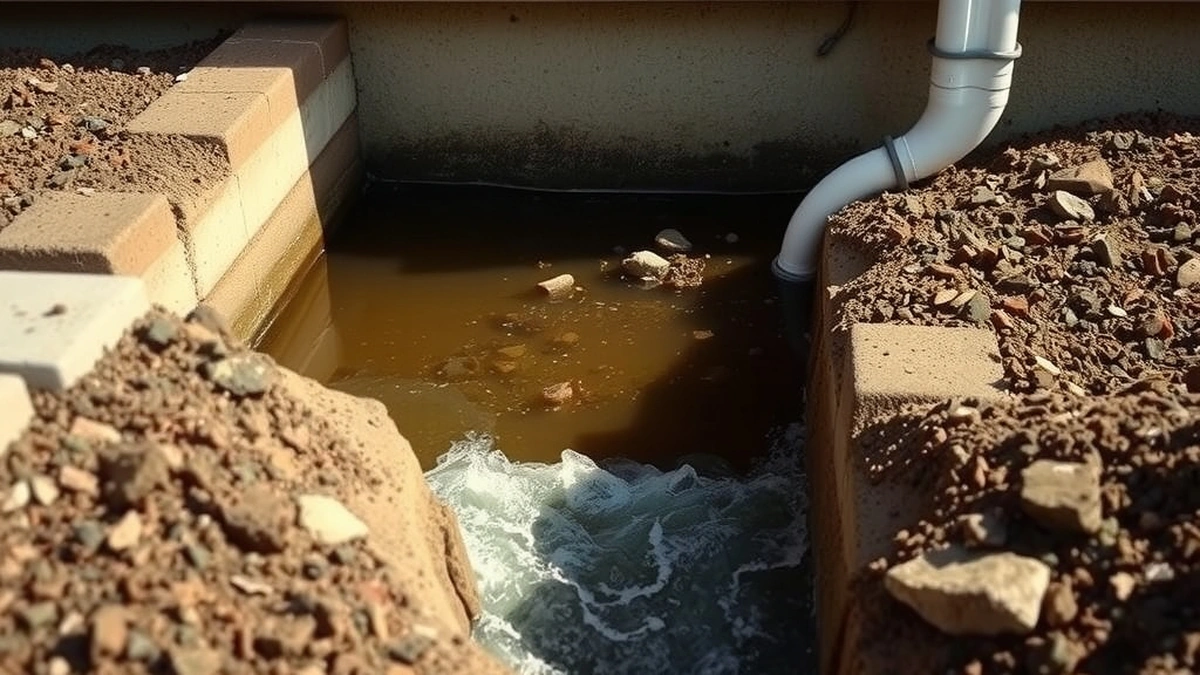
French drain problems include silt clogging, flat or reverse slope, stone with too many fines, crushed pipe, and a discharge that returns water to the foundation. A rebuild costs $2,000 to $6,000.
- Typical cost
- $2,000 - $6,000
- Minimum slope
- 1% (1 inch per 8 feet)
- Pipe diameter
- 4 inches
- Service life
- 20 - 30 years
- Flush frequency
- Annually
Some links on this page are affiliate links.If you buy through them we may earn a commission at no extra cost to you. We do not accept payment for rankings. Read the full disclosure.
French drain problems are usually installation problems that show up years later. Silt fills the pipe, the slope settles out, the stone turns out to be crusher run, and the discharge quietly returns water to the wall. A drain that was never right does not become right with age, and the symptoms are easy to misread as a new foundation problem, which is how a $3,000 drain becomes a $15,000 pier quote.
Symptom One: Water Ponds Above the Trench
Standing water over the drain line means the water is not entering the pipe fast enough. Either the stone is clogged with fines, the fabric is blocked, or the pipe is full of sediment.
The test is simple and requires no tools beyond a bucket. Pour a bucket of water into the cleanout and watch how fast it drains. If it backs up, the problem is in the pipe. If it drains but the ground still ponds, the problem is the filter around the pipe.
Symptom Two: The Soil Stays Wet
A drain that runs but leaves the soil saturated is a drain with a slope problem. Water moves along the pipe until it reaches a low point, and if that low point is not the outlet, it sits there.
A laser level along the trench line will show whether the fall is continuous, and a string line works if the trench can be reopened. A pipe that rises anywhere along its run will trap water, and trapped water eventually becomes sediment. The trap is sometimes caused by a vehicle driving over the trench or by backfill that was not compacted.
Symptom Three: The Basement Is Still Damp
| Cause | Check | Fix |
|---|---|---|
| Discharge returns water | Walk the outlet | Extend or redirect |
| Pipe collapsed | Camera inspection | Excavate and replace |
| Stone has fines | Look at the excavation | Rebuild with washed stone |
| Drain too shallow | Measure depth | Rebuild to footing |
The discharge is the most common and the cheapest to fix. A drain that ends 3 feet from the wall is not draining anything; it is recycling water into the same soil, and the pump or the wall takes the blame for a plumbing mistake.
Stone and Fabric
Washed stone is the specification, usually 3/4 inch and free of dust. Crusher run, which contains stone dust, packs tight and blocks water. A crew that uses whatever is on the truck saves a delivery and ruins the drain, and the failure takes two or three years to show.
Fabric separates the stone from the soil. Without it, fines migrate into the gravel and the drain silts up from the outside in. Fabric that is torn during backfill does the same thing more slowly. The fabric should overlap at the top of the stone so the soil never touches the gravel directly. Check the fabric before backfill; a tear at a joint is easy to fix and impossible to see later.
A Costed Rebuild
A 50-foot drain rebuilt after a clog:
Excavation: 50 × $30 = $1,500 Washed stone: 12 cu yd × $55 = $660 Pipe, fabric, and fittings: 50 × $10 = $500 Discharge work: $400
Total: $3,060, which sits inside the $2,000 to $6,000 band.
The Limits
A french drain handles groundwater at the depth it is installed. It does not stop water that rises from a deeper water table, and it does not fix a wall that is bowing from soil pressure.
It also needs a discharge. Where gravity is not available, the drain has to feed a sump, and the sump becomes the point of failure. A drain without a working outlet is a buried bathtub, and the water it holds keeps the soil beside the foundation saturated.
The Sequence to Diagnose
- Walk the trench line after rain and note where water ponds.
- Find the outlet and confirm water actually leaves.
- Pour water into the cleanout and watch the flow.
- Check the slope with a laser along the run.
- Inspect the stone at an exposed section.
- Camera the pipe if the flow is slow.
- Rebuild the failed section rather than patching it.
A drain with a collapsed pipe, a reversed slope, or stone that was wrong from the start cannot be repaired in place. The trench has to be reopened and the system rebuilt.
A drain that is simply silted can often be saved. Jet washing, a new cleanout, and a fresh outlet may restore it for a few hundred dollars. The camera inspection is what separates the two cases.
Rebuild cost is the same as the original installation, which is why the first installation should be done correctly. There is no discount for the second trench.
What to Ask a Contractor
Ask what stone will be used and whether it is washed. Ask what slope will be maintained and how it will be checked. Ask where the discharge goes and whether it is legal. Ask for a cleanout at the upstream end, because a drain without one cannot be maintained. Ask, too, whether the outlet is screened, because a screen that clogs is another failure point.
For the method detail, read how french drain works and french drain cost. If the basement is wet across the floor, basement waterproofing problems covers the wider diagnosis.
Frequently asked questions
Why is my french drain not working?
The most common causes are silt blocking the pipe, a flat or reverse slope, stone with too many fines, and a discharge point that lets water return to the foundation.
How do I know if my french drain is clogged?
Water ponds above the trench, the soil stays saturated after rain, or water backs up at the discharge. A camera or a hose test confirms it.
Can a french drain be repaired without digging it up?
Sometimes. Jet washing can clear silt, and a new cleanout can restore access. A collapsed or flat pipe has to be excavated.
What is the right gravel for a french drain?
Washed stone with no fines, typically 3/4 inch, so water moves freely and the pipe does not clog. Crusher run is the wrong material.
How long does a french drain last?
Twenty to 30 years when built with washed stone, fabric, and a proper slope. A drain built with dirty stone can clog in a few years.
Does a french drain need a permit?
It depends on the jurisdiction and whether the discharge connects to a storm system. Check with the local building department before digging.
Sources
Some links are affiliate links.If you buy through them we may earn a commission at no extra cost to you. We do not accept payment for rankings. Read the full disclosure.