How a French Drain Works: Slope, Gravel, Pipe
A french drain collects groundwater in a gravel trench and carries it away. See the slope, the fabric, the pipe, and the cost.
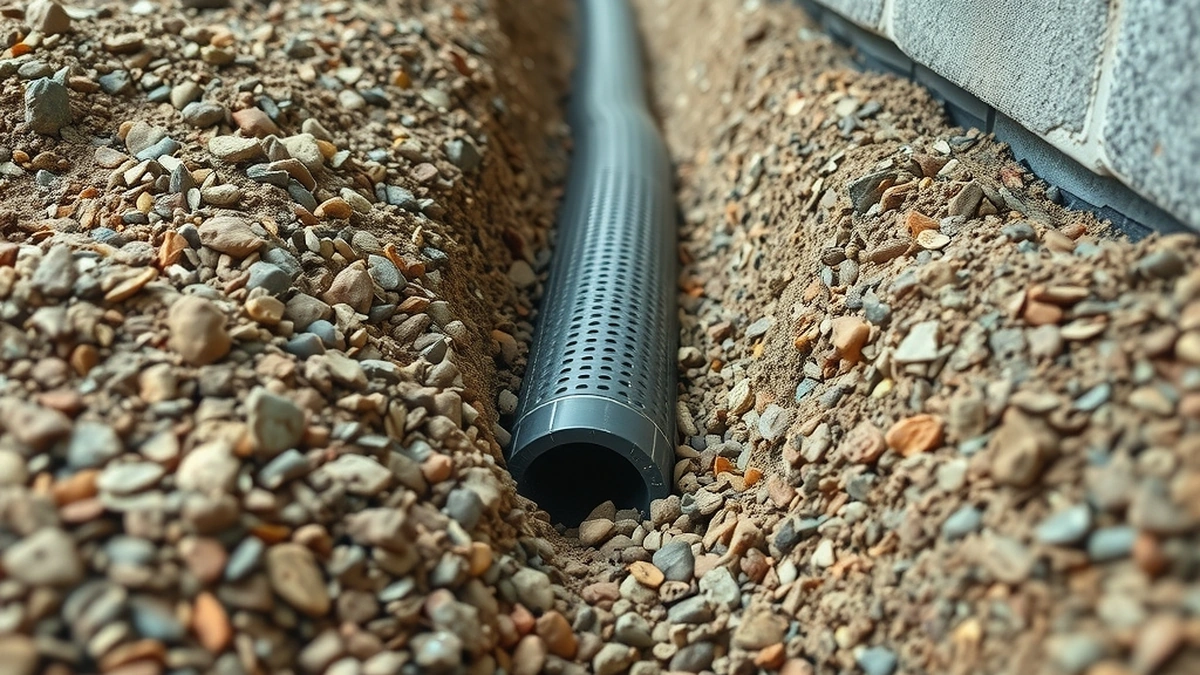
A french drain works by collecting groundwater in a perforated pipe set in a gravel trench and carrying it to a discharge point by gravity. Installed around a foundation, it typically costs $2,000 to $6,000.
- Typical cost
- $2,000 - $6,000
- Trench depth
- 18 - 30 inches
- Pipe diameter
- 4 inches
- Slope
- 1% minimum
- Gravel
- Washed stone, no fines
Some links on this page are affiliate links.If you buy through them we may earn a commission at no extra cost to you. We do not accept payment for rankings. Read the full disclosure.
A french drain works by giving groundwater an easier path than the one through your basement. A gravel trench contains a perforated pipe that collects water and carries it downhill to a discharge point. Around a foundation, the job usually costs $2,000 to $6,000, and the details of stone, fabric, and slope decide whether it lasts.
The Trench
The trench is dug to the required depth, usually 18 to 30 inches for a foundation drain and deeper where the footing is deep. The bottom is shaped to a continuous slope so water always has somewhere to go.
Width matters less than depth and slope. A narrow trench with the right fall outperforms a wide trench that ponds. The bottom should be smooth and free of soft spots, because a pipe that settles out of slope will hold water.
The Stone and Fabric
Washed stone is the standard bedding. It is clean, so it does not clog the pipe, and it creates voids that let water move freely. Stone with fines, or crusher run, packs tight and defeats the purpose.
Landscape fabric separates the stone from the surrounding soil. Without it, fines migrate into the gravel and the drain silts up. The fabric goes on the sides and over the top, lapped so soil cannot enter.
The Pipe
The pipe is typically 4-inch corrugated HDPE with perforations. It is laid with the holes down or up depending on the design, and the choice matters: holes down collect water from below, holes up collect from above and are less likely to clog with sediment.
The pipe needs a continuous fall of about 1%, which is 1 inch per 8 feet. A laser or a string line makes that easy to check. Check the fall before the pipe is covered, because after backfill the only way to fix a flat section is to dig it up again. A pipe that runs uphill anywhere along its length will trap water and eventually fill with sediment.
A foundation drain runs parallel to the wall, usually 1 to 2 feet out from the footing, at a depth that reaches the base of the footing. A yard drain runs across the slope to intercept surface water before it reaches the house.
The two are different jobs. A foundation drain solves water at the wall. A yard drain solves water crossing the property. Putting a yard drain against the wall without reaching the footing leaves the footing water untouched, which is why placement is part of the design.
Discharge
The discharge point is where most drains fail. Water has to leave the pipe and go somewhere it will not return. A gravity outlet to a lower grade is ideal. A dry well works if the soil drains. A sump pit and pump are the fallback when gravity is not available.
A drain that discharges 2 feet from the foundation is not a drain. It is a device for moving water from one side of the wall to the other, and it will find its way back. Extend the outlet to a slope, a storm drain where allowed, or a dry well sized for the volume.
A Costed Example
A 50-foot foundation drain:
Excavation: 50 × $30 = $1,500 Gravel: 12 cu yd × $55 = $660 Pipe and fabric: 50 × $8 = $400 Discharge and fittings: $400
Total: $2,960, which sits in the $2,000 to $6,000 band.
French Drain Versus Sump Pump
| Feature | French drain | Sump pump |
|---|---|---|
| Power needed | No | Yes |
| Cost | $2,000 - $6,000 | $600 - $3,000 |
| Best for | Gravity discharge | Below-grade collection |
| Failure mode | Clogs, settles | Power loss, pump failure |
| Maintenance | Flush annually | Test twice a year |
The two work well together. A french drain collects and a sump pumps when gravity cannot carry the water away. A sump without a drain collects only what reaches the pit, and a drain without a sump can do nothing when the outlet is below grade. Together they cover both conditions, which is why the two are often quoted as one system.
The Installation Sequence
- Locate utilities before digging.
- Mark the trench line and the discharge point.
- Excavate to the required depth with a continuous slope.
- Line the trench with fabric and add washed stone.
- Lay the pipe, check the fall, and connect the outlet.
- Cover with stone, wrap the fabric, and backfill.
- Test with a hose before restoring the surface.
Why Drains Fail
Most failures are installation errors rather than material failures. Stone with fines clogs. Fabric that is missing or torn lets soil in. A pipe laid flat holds water. A discharge that is buried or blocked stops the flow.
The rest are maintenance. A drain that was installed correctly and never maintained will still silt up, but it will take a decade rather than a season. A drain that is never flushed will eventually silt up, especially where the soil is fine. Flushing once a year with a hose extends the life considerably. A drain that has a cleanout at the upstream end is much easier to maintain than one that has to be opened from the discharge.
For the cost detail, read french drain cost and foundation drainage cost. If gravity discharge is not possible, french drain versus sump pump explains the combination.
Frequently asked questions
How does a french drain work?
Water enters the gravel trench, flows into the perforated pipe, and runs downhill to a discharge point. The gravel filters the soil and the fabric keeps fines out of the pipe.
How much does a french drain cost?
Around a foundation it runs $2,000 to $6,000 depending on length, depth, discharge, and access. A simple yard drain costs less.
How deep should a french drain be?
For foundation drainage, the trench typically goes to the footing, 18 to 30 inches below grade. A shallower drain handles surface water only.
Does a french drain need a slope?
Yes. A minimum fall of about 1% is needed for gravity flow, which is roughly 1 inch per 8 feet. A flat pipe will clog and fail.
Can a french drain be installed without gravel?
Some systems use a fabric-wrapped pipe or a geocomposite drain. Gravel remains the most common and forgiving approach for residential work.
How long does a french drain last?
A properly built drain with washed stone and fabric can last 20 to 30 years. A drain filled with dirty gravel or without fabric can clog in a few years.
Sources
Some links are affiliate links.If you buy through them we may earn a commission at no extra cost to you. We do not accept payment for rankings. Read the full disclosure.