Do It Yourself Foundation Repair: What Is Safe
Homeowners can monitor cracks, seal leaks, and fix grading. Piers, lifting, and structural work need an engineer and a contractor.

Do it yourself foundation repair is limited to monitoring, sealing stable cracks, and correcting grading and downspouts. Piers, lifting, anchors, and any structural work need an engineer's design and a licensed contractor.
- Crack gauge
- $10 - $40
- DIY crack sealant
- $20 - $80
- Downspout extension
- $15 - $60
- Regrading
- $1,500 - $4,000
- Pier repair
- $6,000 - $30,000
Some links on this page are affiliate links.If you buy through them we may earn a commission at no extra cost to you. We do not accept payment for rankings. Read the full disclosure.
Do it yourself foundation repair is real, but it is narrower than the videos suggest. A homeowner can monitor cracks, seal a stable leak, and fix the grading and downspouts that cause most movement. Piers, anchors, lifting, and anything structural need an engineer’s design and a licensed contractor.
What You Can Do Safely
Monitoring is the first task. A crack gauge costs $10 to $40, and a 4-foot level costs about $20. Record the width at the widest point, photograph it with a scale, and repeat monthly.
Sealing a stable crack in a wall or a slab is the second. A polyurethane sealant and a backer rod cost under $80, and the job takes an afternoon. It stops a leak but does not restore strength, and it does not stop the wall from moving if the cause is still present.
The Monitoring Record
| Date | Crack width | Floor slope | Note |
|---|---|---|---|
| Month 1 | 1/8 inch | 1 inch in 12 ft | Baseline |
| Month 2 | 1/8 inch | 1 inch in 12 ft | Stable |
| Month 3 | 3/16 inch | 1.25 inch in 12 ft | Widening |
A record like that is worth more to an engineer than any description, because it shows the rate of movement.
Grading and Downspouts
The cheapest real repair is water management. Extend every downspout 4 to 6 feet from the wall, and grade the soil to a 6-inch fall over 10 feet.
Both are homeowner tasks on a small scale. A downspout extension costs $15 to $60, and a few cubic yards of soil and a weekend can fix a low spot. Larger grading work is better hired.
What Not to Attempt
Do not install piers. A pier requires a design, a load calo Attempt
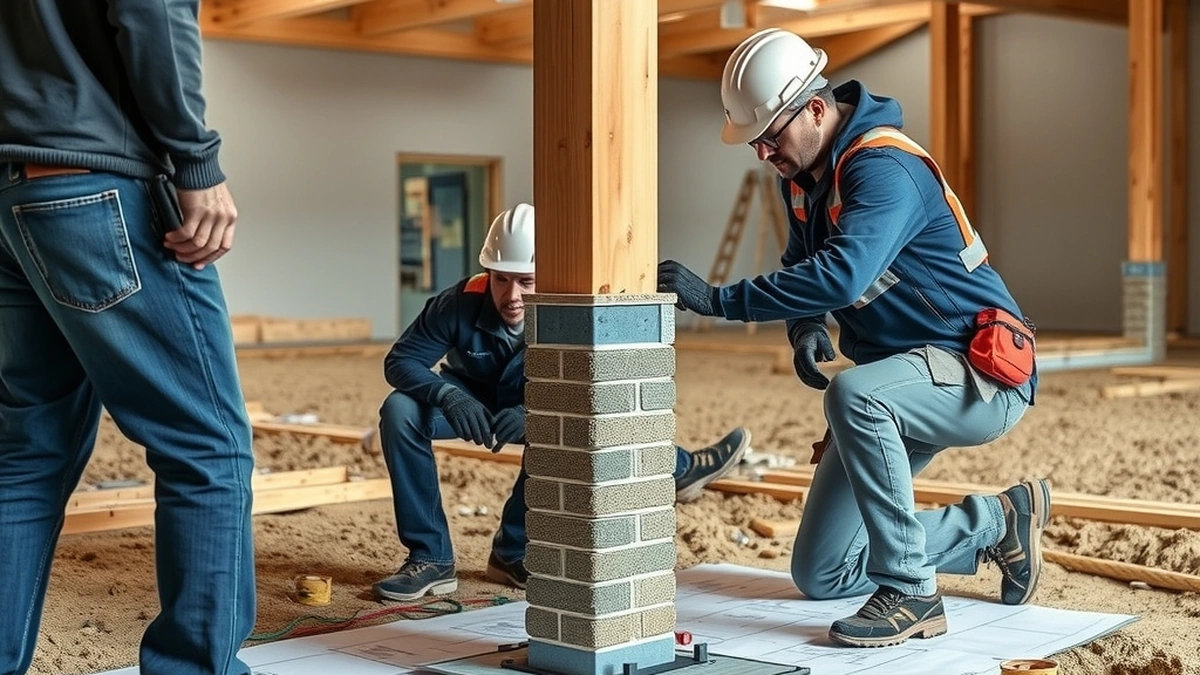
Do not install piers. A pier requires a design, a load calculation, a bearing depth, and hydraulic equipment, and a failed installation is worse than no installation.
Do not lift a house. Lifting moves the frame, the plumbing, and the cladding, and the tolerance is measured in fractions of an inch. It is not a homeowner task at any level of confidence, and the equipment is not sold to homeowners for a reason, which is itself a signal.
The Crack Injection Question
Injection kits are sold for slabs and garage floors, and a careful homeowner can use one on a non-structural crack in flatwork. The kits cost $50 to $150 and the result is usually acceptable.
A basement wall is different. The crack may be a symptom of movement, the pressure has to be controlled, and a failed injection leaves a mess that a contractor has to remove. The savings on a wall crack are small compared with the risk, and the diagnosis that comes with a professional job is worth part of the price.
When to Call Someone
Call a contractor or an engineer when a crack reaches 1/8 inch, when a wall is out of plumb by more than an inch, when a floor has dropped more than an inch across a room, or when a door sticks year round.
Those thresholds are the point where the repair moves from maintenance to structure, and the cost moves with it.
The Cost of Getting It Wrong
A homeowner who tries to lift a slab with a bottle jack can crack the concrete and create a trip hazard. A homeowner who excavates along a footing to “relieve pressure” can undermine the very support the wall needs.
The failures are not always dramatic, and the quiet ones are often the most expensive. A badly sealed crack that traps water can accelerate freeze-thaw damage, and a regrade that directs water toward a neighbour’s lot can create a legal problem.
The Safe DIY List
- Measure and record crack widths monthly.
- Photograph everything with a scale and a date.
- Extend downspouts and clean gutters.
- Regrade small low spots away from the wall.
- Seal a stable, non-structural crack in flatwork.
- Keep a folder of records for the engineer.
DIY foundation repair is about diagnosis and water, not about structure. The homeowner who monitors carefully and fixes the water saves money and gives the engineer better information. The homeowner who tries to install a pier saves nothing and risks a great deal, and the risk is not only financial.
A homeowner who wants to do more should consider the tools rather than the structure. A laser level at $80 to $200 measures floor elevation accurately, and a moisture meter at $40 identifies a damp wall before it becomes a mould problem.
Those tools support the monitoring and the water management, which are the two areas where homeowner effort produces a real return. They do not make a pier installation safe.
Photograph the utilities before any digging. A homeowner who strikes a gas line while regrading has created an emergency, and the repair cost dwarfs the saved labour.
Keep the record in one place: the crack readings, the photos, the receipts, and the contractor reports. A clear file shortens every future conversation, and it is the one part of the work that has no downside.
For the cost of the professional version, read foundation repair cost and how much does foundation repair cost. If a crack is already at 1/8 inch, foundation repair inspection explains what the engineer will do.
Frequently asked questions
Can I repair my foundation myself?
You can monitor cracks, seal a stable non-structural crack, and fix grading and downspouts. Structural repair such as piers, anchors, or lifting should be engineered and installed by a licensed contractor.
Is DIY crack injection safe?
Kits are sold for slabs and garage floors. A basement wall crack that is leaking or moving should be assessed first, because injection does not fix movement.
What tools do I need to monitor a crack?
A crack gauge, a 4-foot level, a camera, and a notebook with dates. The total cost is under $60 and the record is valuable to any engineer.
Can I regrade my yard myself?
Small grading adjustments are a homeowner task. Moving significant soil, correcting drainage, or working near utilities is better hired out.
How do I know when to call a contractor?
When a crack reaches 1/8 inch, a wall is out of plumb, a floor has dropped more than an inch, or a door sticks year round.
Will DIY repairs void a warranty?
Work by the homeowner in the repaired area can void a contractor's warranty. Ask before doing anything inside a warranted zone.
Sources
Some links are affiliate links.If you buy through them we may earn a commission at no extra cost to you. We do not accept payment for rankings. Read the full disclosure.