Carbon Fibre vs Steel Straps for Foundation Walls
Compare carbon fibre and steel straps for bowing basement walls, including cost, installation, and when each method applies.
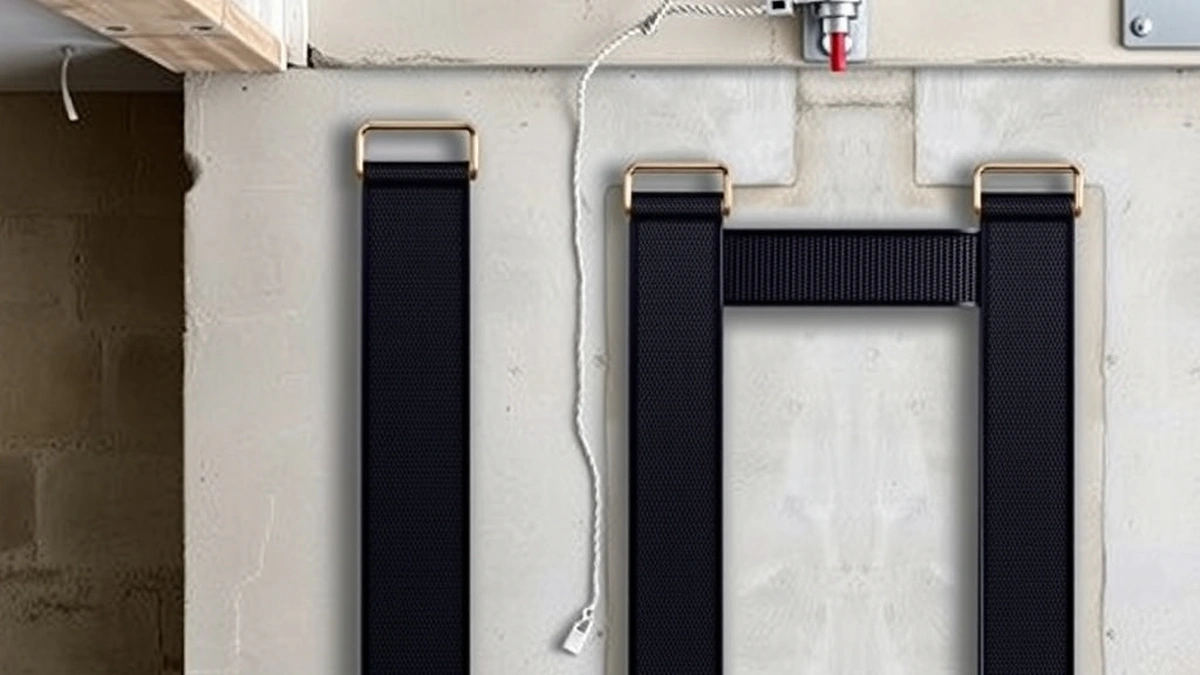
Carbon fibre straps suit minor inward movement with minimal excavation; steel straps handle heavier loads but require more invasive anchoring. Cost typically runs $400–$1,200 per strap installed.
- Best for minor movement
- Carbon fibre straps
- Best for heavier loads
- Steel straps
- Typical strap cost
- $400–$1,200 each
- Wall movement limit
- 2 inches
Some links on this page are affiliate links.If you buy through them we may earn a commission at no extra cost to you. We do not accept payment for rankings. Read the full disclosure.
Carbon fibre and steel straps both stabilize bowing basement walls, but they are not interchangeable. Carbon fibre straps work best for limited inward movement and minimal interior disruption, while steel straps resist higher loads through bolted anchorage. The right choice depends on measured crack width, wall displacement, and how far the wall has moved.
What Carbon Fibre and Steel Straps Do
Straps are surface-applied reinforcement systems for concrete or masonry foundation walls that are bowing inward from soil pressure. They do not lift a settled foundation or replace failed piers. Their job is to arrest movement and distribute lateral load back into the wall.
Carbon fibre straps consist of high-tensile fabric bonded to the wall with structural epoxy. They are typically a few millimeters thick and can be painted over once cured. Steel straps are flat steel bars, commonly galvanized, bolted through the wall and connected to the floor joists above and the foundation footing below.
Neither strap type addresses the root cause of soil pressure on its own. If drainage, grading, or gutter issues are pushing against the wall, those conditions should be corrected alongside any strap installation.
How They Are Installed
Carbon fibre installation starts with surface grinding to expose clean concrete, followed by epoxy application and strap placement. The wall must be structurally sound enough to accept the bond. Because there are no through-bolts, the process is faster and produces less dust and interior disturbance.
Steel strap installation requires drilling through the wall, bolting the strap to the interior face, and anchoring the top to the floor framing and the bottom to the footing or slab. This creates a mechanical load path from the wall into the house structure. It is more invasive than carbon fibre and may require cutting floor slab sections near the wall.
Both systems are spaced based on wall height and the engineer’s design. A common layout places straps every 4 to 6 feet along the affected wall length, though exact spacing depends on the wall’s thickness, height, and measured deflection.
Strength and Movement Limits
Straps are appropriate only within defined movement limits. Foundation Repair Lab uses a wall movement limit of 2 inches. If a wall has bowed more than 2 inches, straps alone are generally not sufficient, and wall anchors, helical piers, or partial wall replacement may be required.
Crack width also informs the decision. Cracks at or below 1/16 inch are typically cosmetic. Cracks at or above 1/8 inch warrant monitoring and possible structural repair. Straps do not “close” cracks; they restrain further movement. Any crack repair should be measured and documented before straps are specified.
Steel straps have higher tensile capacity than carbon fibre and can carry greater point loads at bolted connections. Carbon fibre relies entirely on the bond between epoxy and concrete, so surface preparation and concrete condition matter more. If the wall face is spalled or deteriorated, carbon fibre may not develop full capacity.
Cost Comparison
Strap pricing is quoted per unit installed. The canonical estimate range for carbon fibre straps is $400 to $1,200 each. Steel strap pricing is similar in many markets, but installation labor can push the total higher because of drilling, anchoring, and floor patching.
Below is an illustrative cost model for a 20-foot basement wall requiring five straps spaced at 4-foot intervals.
| Item | Quantity | Unit Price | Line Total |
|---|---|---|---|
| Carbon fibre straps | 5 | $400–$1,200 | $2,000–$6,000 |
| Steel straps | 5 | $400–$1,200 | $2,000–$6,000 |
| Engineer inspection | 1 | $400–$1,500 | $400–$1,500 |
| Estimated total | $2,400–$7,500 |
These figures are estimates and do not include crack injection, drainage correction, or wall anchor installation. For context, a full pier job often runs $6,000 to $30,000, while wall anchors cost roughly $500 to $1,500 each. Strap repair is usually less expensive than piering or replacement, but only when wall movement remains within strap limits.
Arithmetic example: if a contractor quotes $800 per carbon fibre strap and the wall needs six straps, the material and installation subtotal is 6 × $800 = $4,800. Adding an engineer inspection at $900 brings the project estimate to $5,700 before any additional crack repair or drainage work.
When to Choose Each
Choose carbon fibre straps when:
- Measured wall movement is minor and within the 2-inch limit.
- Interior finish disruption must be minimized.
- The wall face is sound enough to accept epoxy bonding.
- The wall will be painted or finished after repair.
Choose steel straps when:
- The wall carries higher lateral loads or shows more significant bowing within allowable limits.
- A mechanical connection to floor framing and footing is preferred.
- The wall face is unsuitable for epoxy bonding but can accept through-bolts.
- The design specifies steel for code or engineer requirements.
Straps are not a substitute for piers when the foundation is settling or when footing bearing has failed. If the issue is vertical movement rather than lateral wall pressure, push piers or helical piers are the appropriate repair. Push piers cost approximately $1,000 to $3,000 each, while helical piers cost roughly $700 to $2,500 each.
Warranty and Long-Term Considerations
Strap warranties vary by contractor and manufacturer. Unlike pier warranties, which are often described as lifetime and transferable, strap warranties may be shorter and may not transfer to a new owner. Where transfer is allowed, fees typically range from $100 to $500.
Carbon fibre is corrosion-resistant and does not require maintenance after curing, though the epoxy bond should be inspected if the wall shows new movement. Steel straps can corrode in damp basement environments unless properly coated or galvanized. Surface scratches or cut edges should be monitored over time.
Permits vary by city and county and typically take 1 to 3 weeks to obtain. Inspection lead time is usually 1 to 2 weeks after scheduling. Homeowners should confirm permit requirements before work begins.
Bottom Line
Carbon fibre and steel straps both stabilize bowing walls, but they serve different conditions. Carbon fibre offers a low-profile, less invasive option for minor movement, while steel provides higher load capacity through mechanical anchorage. Measure crack width and wall displacement first, confirm the wall is within the 2-inch movement limit, and obtain an engineer inspection before selecting a system. Costs typically fall between $400 and $1,200 per strap installed, making strap repair one of the lower-cost structural options when conditions are suitable.
Next, compare foundation repair cost, pier and beam foundation repair cost, foundation crack repair cost before you commit.
Frequently asked questions
What is the main difference between carbon fibre and steel straps?
Carbon fibre straps are thinner and bond to the wall face with epoxy, while steel straps are bolted through the wall and anchored to the floor framing and foundation footing.
How much does one strap cost installed?
Installed strap costs typically range from $400 to $1,200 each, depending on wall conditions, access, and regional labor rates.
Can straps fix a wall moving more than 2 inches?
No. Walls moving beyond the 2-inch structural limit generally need wall anchors, piers, or replacement rather than surface straps alone.
Do straps require excavation outside the home?
Carbon fibre straps usually do not. Steel straps often require interior floor anchoring and may involve more disruptive installation than carbon fibre.
Are strap repairs transferable if I sell the house?
Transferability depends on the contractor and warranty terms; transfer fees typically run $100 to $500 where allowed.
Should I get an engineer's inspection before choosing straps?
Yes. An engineer inspection usually costs $400 to $1,500 and confirms whether straps are appropriate or if the wall needs piers or anchors.
Sources
Some links are affiliate links.If you buy through them we may earn a commission at no extra cost to you. We do not accept payment for rankings. Read the full disclosure.